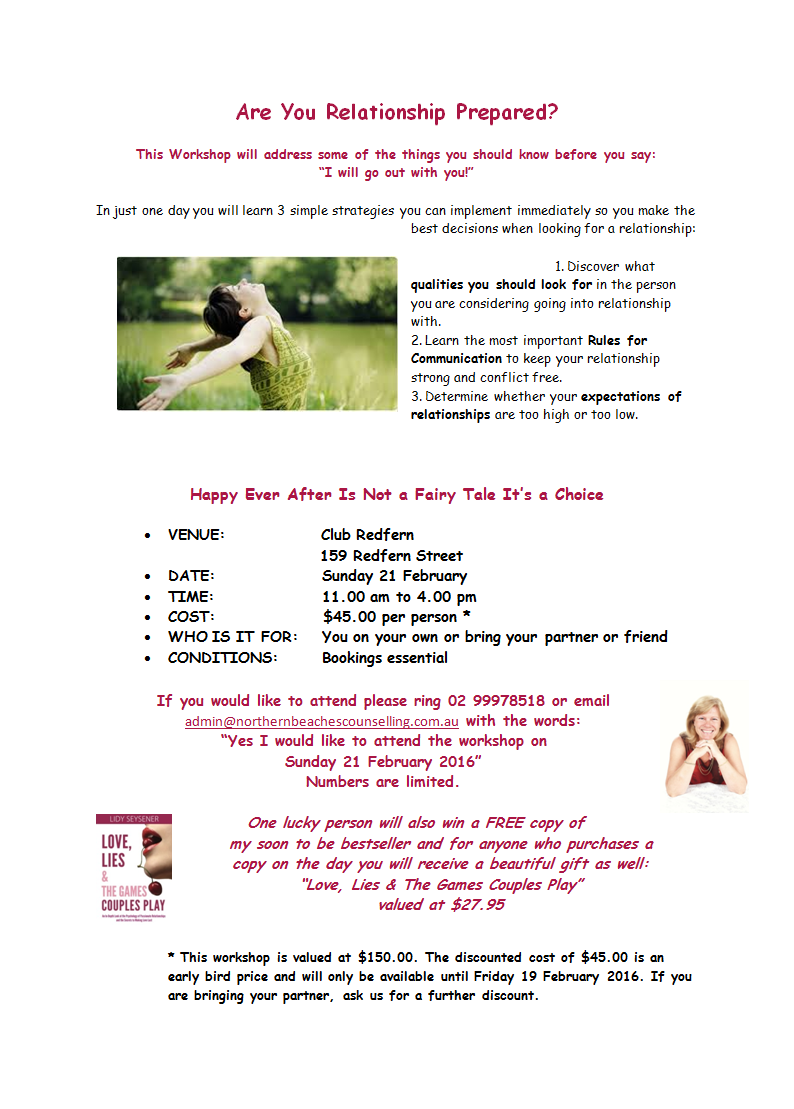
Click on the flyer to see it in full size.
If you would like to attend the seminar please ring 02 99978518 or email admin@northernbeachescounselling.com.au with the words: “Yes I would like to attend the seminar”.
Click on the flyer to see it in full size.
If you would like to attend the seminar please ring 02 99978518 or email admin@northernbeachescounselling.com.au with the words: “Yes I would like to attend the seminar”.
Click on the flyer to see it in full size.
If you would like to attend the seminar please ring 02 99978518 or email admin@northernbeachescounselling.com.au with the words: “Yes I would like to attend the seminar”.
 A common question I’m asked after a couple has just had a child is: “When can we have sex again?” The short answer is: “When it feels right”. Sadly it is most often he who is ready before she is so when it doesn’t happen as he expects then this can lead to feelings of frustration and even alienation from the new mum and her baby.
Low or absent sexual desire is a very common experience after pregnancy; a reduction in sexual interest and activity, compared with pre-pregnancy levels, is really the norm during the first few months.
Studies have found that more than half of women resume intercourse at six weeks after delivery; By 24 weeks more than 80% of women were ready to be sexual again. The majority of the women even reported being able to come to orgasm by 12 weeks. And most studies indicate a gradual return to pre-pregnancy levels of sexual desire, enjoyment, and coital frequency within a year.
The return to making love is strongly influenced by the mother’s experience before pregnancy, her physiology, and her emotional and psychological make-up as well as by the culture she has been raised in.
The physical impact of giving birth is generally complete somewhere between four and six weeks. Research has shown that this differs little between those who have given birth vaginally as opposed to those who have had a cesarean birth. However the mother may still be weary for some time especially if the baby is not feeding well or is restless and taking time to settle down to a good sleep routine.
And then there is the emotional impact which may take longer to recover from. Here also every woman makes progress in her own time and in her own way.
Emotional disturbance very often takes the form of post natal depression, sometimes affectionately called, “post natal blues”. This can be as mild as feeling restless or as serious as contemplating harming the child or the mother herself.
While ensuring that the mother’s milk supply stays high, breastfeeding can negatively affect sexual desire whilst also guarding against a future pregnancy too soon. The reason is that estrogen levels decline during breastfeeding, which, sadly, also means that sexual interest also declines.
Vaginal lubrication also decreases which can lead to pain with intercourse which is also a way of ensuring that you don’t get into mischief while your new baby still needs so much of your attention.
The baby also makes sure that the mother’s attention is totally on her or him to ensure that this child has the best chance of surviving without having to compete with anyone else. This includes the father who, so far as this child is concerned, has fulfilled his part of the bargain.
Firstly it means that as well as dealing with a new baby and all that entails it also means that you now have to patiently focus your energies on this child until you are not required 24/7 anymore.
In the meanwhile you can start to take any moment this child allows you to do some nice things for each other that are not necessarily going to lead to intercourse. Bathe together, massage each other, have a sleep in, if your baby will let you, and rest when your baby is asleep rather than trying to use this time to catch up on chores. Also take time out, as it is offered by friends and family, to go out and share a meal together or go to the movies.
Other forms of sexual expression, such as touching, kissing, and mutual pleasuring techniques, besides just being nice to do, can also help to re-establish physical closeness with your partner. So take your time getting to know each other again.
Then when the time is right, begin to reintroduce more sexually based activities into your schedule. The use of water-based vaginal lubricants can help reduce discomfort during intercourse. Vaginal moisturizer also can relieve vaginal dryness and pain.
And don’t be in too much of a hurry to get to intercourse. Masturbate each other or with each other until you are both sufficiently aroused to take it to the next step.
And don’t forget to use some form of contraception. Breastfeeding is not a guarantee against falling pregnant. And I should know as that is how I conceived my fourth child seven months after delivering my third and whilst still breast-feeding and feeling absolutely exhausted chasing after two other pre-schoolers.
Finally, take heart. Enjoyment of sexual intercourse will return, even if it is gradual, after childbirth. Give it time and enjoy the little bundle of joy you have created from your love for each other.
So until next time – Relate with Love


For me the most important part of being married is that you do consider your partner to also be your best friend: There for you in good times and in bad, in sickness and in health. And who but a best friend would do that?
Maybe this could even mean that if your partner is not your best friend then they will probably not be around long as your partner either.
“I have never thought of any of my partners as best friends and have ‘separate’ best friends all along.”
I wonder when I hear a statement like this what sort of relationship this person has with their partner and how this might actually vary from their relationship with their best friend.
And while having said that, this actually might become the case in the nitty-gritty of relationships when there may be certain things that I might discuss with a best friend, sometimes even about my partner, that I would not share with my partner, as well as there being certain things I might talk with my partner about, sometimes even about my friends, that I would not share with my friends.
But when it comes to the really important things like making decisions that affects us both, or when it comes to exposing the very most vulnerable part of ourselves then your partner is fairly likely the only person who would ever see that and know about that part of you.
This is probably why it is that your partner can hurt you the most and often even more so than friends. While friends can disappoint you, in their misuse of the trust you place in them, by sharing something that was meant for them only, your partner can do much more harm by knowing what your weak spot is and by hitting you there the hardest.
And for those of you who really struggle with your relationship with your partner, even to the point of trusting your best friends more, then something is seriously wrong with your relationship that needs to be addressed if your relationship is going to make it long-term.
What is worth remembering here is that sometimes the issues that are present in your current relationship stem from your life experience growing up as you observed your own parents’ struggle with their relationship. Often fear is brought with you from those earlier experiences that lead you to distrust your partner, just as your mum or dad may have distrusted their partner. As you witness that you make decisions from what you’ve seen or heard that then becomes your guide into your own adult relationships.
So if this is you and you are struggling with your relationship: if you hesitate allowing your partner to be your best friend then maybe it’s time to take a closer look at what is really going on in this relationship.
Let me just add this: there are, of course, relationships that cannot be considered in this way as they are with individuals who are abusive of you. If this is your situation then you might need to make a decision about whether you can be in this relationship at all. You may also need to make a decision for your safety that allows you to find a way out that doesn’t leave you more vulnerable to your partner’s abuse. This is a time when your friends really can become more important; as a support for you during such a difficult time. I’ll say more about this on another day.
So until next time – Relate with Love
 A question I received just recently was from a young man who said that he falls in love at the drop of a hat, or maybe that should read heart, and then just as quickly feels an equally strong need to withdraw from the relationship when it gets to the part that she is asking for more of a commitment.
I was told that everything is just great until the moment it seems that the woman starts to ask questions like ‘where are we going?’ at which time he gets an overwhelming sense of dread and a need to just pull out of the relationship. He says he just wants to ‘run with fear!’
So the question is: ‘why, when everything looks and feels perfect, does he do this?’
The answer can be found in his statement: ‘run with fear!’ because it is fear that is driving it. So without an opportunity to explore his background further the answer maybe either in a past experience between someone who was very important to him, such as his parents, or from a previous experience of his own in which he might have been deeply hurt and has not yet fully recovered.
All our past experiences affect how we respond to what is happening to us now. So if our past experiences have been positive then so will our present experiences be positive and if our past experiences have been negative so will our present experiences be unless we have taken the time to review those experiences, learned what we need to learn from them to ensure a comfort within ourselves that we will not make the same mistakes again.
When we have done this satisfactorily then we can enter into new experiences without the past impacting on the outcome. And sometimes we need some extra help with this and that is where counselling can play a truly valuable role.
I often wonder when I hear people say that there is no such thing as love. The reason for such thinking is that, most likely they have been deceived by someone in the past, so they become cynical and begin to say that love does not exist.
They do so because they do not want to get hurt again, but in saving themselves, they hurt many other people by first getting into a relationship and then shying away telling their partner that they do not love them when what they probably really want to say is simply: ‘I’m scared’.
If this describes you take a good look inside of yourself and be really honest with yourself. Is this about no love or is this really that you are scared. If it is because you are scared help is at hand. No-one should spend their days alone because of something that happened a long time ago.
And if it really is that you think that you just want to spend some time with someone, and not really commit to a relationship, then you should let the other person know that you are not into anything serious and that you will not commit to them. You should tell this to them in the beginning, rather than breaking their heart afterwards.
If you are not in love then you cannot be happy in a relationship because the relationship does not really exist. To get the most out of your life and out of your relationship firstly do the work you need to do to be finished with any past relationships and then open your heart and your soul to all the joy that true love, without any fear, can offer you.
So until next time – Relate with Love

There’s a joke told about politicians that goes like this: “How do you know when a politician is lying?” The answer: “When his lips are moving!”
The truth is we all tell lies!
The more modest ones are called “white lies”; they are generally harmless and don’t upset people too greatly if discovered. Such lies tend to be said to save someone’s feelings, like when we compliment someone about how they look, or to save our own, such as when we make up reasons for my not being able to do something when we really don’t want to do it anyway.
Lies can be by what is said as well as by what is not said.
Men and women tell different kinds of lies. Men most often tell lies to protect themselves. They may lie to you about the way you look; they may say that you look good no matter what you wear. They just do not want to break your heart; they want you to be happy. Such lies are very sweet; in fact, if your man tells you such lies, then you should be very happy. He truly loves you.
Men may also lie about the things they can do. Men always have an ego factor, all human beings have, but it is found in men to a much greater extent. They can never let someone bruise their ego. Therefore they lie about the things they are capable of doing. They may say that they can do something or have done something where in reality they may not be able to do it at all. This sometimes presents itself in their boasting about women they have been with.
Sometimes men just lie about household chores such as the bills, grocery or fixing something. They may tell you that they have done something, when they might not have done it.
Men sometimes lie when they are cheating. Their intention is not necessarily always to deceive. Sometimes they have good intentions. He may be lying about cheating because he feels guilty that he cheated on you. He may even lie to you because he is afraid of losing you. He might have huge regrets about cheating on you.
So while men often lie to protect themselves from someone else’s outrage, women are more likely to lie in order to protect someone else. This might be to protect their children from being in trouble for some misdemeanor against the other parent or to help a girlfriend who needs someone to cover for her or to support her in front of her partner or other girlfriends.
Women are also more likely to lie about others, particularly other women and do so as a way of making the other seem less attractive.
These lies may be bad enough but then there are the lies that are more serious and which really hurt relationships such as when we lie because we are concerned that the other person might respond in a particularly angry way, maybe rightfully so, or because we have really done something wrong and for which we are feeling guilty.
In amongst these are the lies that are told with the complete intention of hurt or betrayal. They might be cheating on you and they are not telling you because they want to have their wife and mistress, or for women they want their husband and boyfriend, both at the same time.
Some people lie to you for financial reasons, because if you found out about their cheating or gambling, you may feel you need to leave the relationship.
And of course there are those who lie to themselves in order to justify what they do.
Just keep one thing in mind, when you suspect that someone is lying to you try not to see the lies, try to see the intention. If the intention is good and they did not want to hurt you, then you should find a way to forgive. But if they intended to cheat you, then something much more sinister is at play and this needs to be exposed and dealt with before it gets out of hand particularly as it might be a threat to your whole relationship with them.
So until next time – Relate with Love

I received this very sad letter not so long ago so am making it the focus of this blog article.
“Why is it that I and my girlfriend quarrel/argue every week for she says she doesn’t trust me and tells me every time that she doesn’t want to marry me?
I love her so much and want her be my wife. I have thought of things that she thinks that creates the argument, but when i start to work on those things it works a little while but fails and never lasts.
I am standing on two conflicting ideas. Marry her or start over another relationship.
What she says when she gets angry out of nothing gets me crazy. Even now, we are not giving phone calls to each other.
What should I do to keep and maintain happy and healthy relationship with her? I want to give love to her and expect the same response from her. How can I make that happen? When I stop things over, she starts and when I come to understating she pushes me away.
It has been like this for more than two years since I met her. One week it’s okay and another week hell.
Please help me save my relationship.”
Let me start to answer this multifaceted question by firstly saying that all relationships will have times of conflict especially as part of negotiating a long-term relationship. This is part of helping you figure out the ‘rules’ that are going to define how your relationship is to be managed. This involves who will make the decisions and who will be responsible for what aspect of your relationship.
This is a normal part of the transition into the next stage of relationship development as you move away from the symbiosis, the honeymoon stage that defines the first part of all relationships.
So the way through this is firstly to learn some communication skills so that you can each hear clearly what the other is saying before responding. Sometimes it is necessary to bring a professional counsellor/coach into the picture who can teach you how to do this and help you manage the process when things become especially difficult.
The next part of the process is to define what it means to be in relationship and what that relationship should look like to support both of your values of what a loving relationship actually is. Then take the time to ask each other lots of questions to assess whether these values are shared making you compatible as this value compatibility is what will determine whether your relationship has what it needs to make it long-term.
Just as importantly, for relationships to succeed it requires a selflessness that has at its core a willingness to do for another without any thought of what’s in it for me. If we only do for another for what we can get back then we’re not in it for love. And of course if you are both acting from that place then you’ll get what you want anyway but now for the right reasons.
For more information on the stages of relationship go and have a look at my product shop. There you will find several books including one titled “Relationships – A Couples Journey” that addresses the stages relationships go through as part of their natural development. Another book that maybe is helpful is titled “The Games Couples Play” which takes a look at conflict in relationships and how to manage it. You’ll find the bookshop at my website at www.acouplesjourney.com.
So until next time – Relate with Love

It seems like some people just like to complain. No matter what you do, you cannot make them happy. From trivial mistakes to great blunders, they do not let go of a single opportunity to tell you that you’ve done something wrong.
These types of behaviour are really just displays of low self-esteem. These may even be the victims of the world trying just trying to help themselves feel better.
It is very difficult to have and maintain a relationship with such people, because they find it difficult to utter a compliment and maybe even struggle to tell you that they love you. It often just seems like they don’t appreciate you no matter what you do. I’ve even heard people describe them as misers when it comes to giving compliments, and even sometimes in receiving compliments.
These people are also game playing as this is what they are actually doing – playing a psychological game that has only one objective and that is to confirm for them what it us they have already decided about themselves and/or about others.
So if they want to believe that nobody can do anything as well as them or that they are the only ones who know how to do anything at all, or that they themselves are pretty useless but in order to try to feel a little better about themselves they have to bring you down, so that you are then too busy thinking about what you might have done wrong so you don’t discover it’s actually more about them, it’s this that sets the game in motion.
When you try to look at it logically it is. But when you are responding to something you decided on when you were three or four years of age then it makes perfect sense to the unconscious part of your mind that has been harbouring that belief and playing it out again and again making the belief stronger and stronger with each experience which again simply re-confirms those tired old beliefs.
So how do you deal with these kinds of people and with this kind of twisted logic? It’s simple really. You take a position of care for the other and assertiveness for yourself. You must also be in tune with your own vulnerability which might mean that sometimes you need to respond and that sometimes it’s better not to.
This doesn’t mean that you have to roll over and accept what is being said but you must respond thoughtfully or else you can start to feel like you’re on a merry-go-round that is never going to stop.
It is important though to keep in mind that sometimes the complainer will ‘up the ante’, so to speak, and serve you more of the criticism to get the desired outcome, the ‘payoff’ as we would call it in game theory.
The bad news is that if you give in and accept the complaint or criticism as true there is only one of three outcomes possible. These define the outcomes of extreme games and end up in the courtroom, the hospital or maybe even in the morgue.
It might begin somewhat innocently and then escalate until it seems that there is no going back. For example, if you think you can just tell the complainer they are wrong in some matter, or they need to change their attitude the reply you get might be: “I do not need you, if you do not want to be with me you can leave”.
From here it’s likely to become a fast ride to no-where!
So until next time – Relate with Love

There’s a saying I’ve heard, and possibly even said myself, which suggests that the only love that is unconditional is the love of a mother for her newborn baby. The adage goes on to say that maybe this only lasts twenty-four hours or until your first sleepless night.
To answer this question let’s firstly look at what is ‘unconditional love’. Put simply, and as the words would imply, unconditional love is love that is given without the expectation of anything in return.
Conditional love, on the other hand, is the love that is given in response to love received and generally has attached to it something like… “I will love you as long as ….” The conclusion to this phrase might be about something I get from you or something you do for me so might end with “… you take care of me” or “… you give me what I want.”
It would be someone exceptional to truly love when nothing comes back.
Using this definition then it would be someone exceptional to truly love when nothing comes back.
Have you ever seen unconditional love? For most of you, unconditional love is probably just a fairy tale myth which doesn’t exist. For many, love alone has become like a ghost – “everybody talks of it and only a few have seen it”. When you tell someone you love them, most of the time they will be waiting for the “what’s next”, saying there is no such thing as love so there has to be an ulterior motive for someone saying it.
However in this mean and self-centered world, you can still find those people who love, and there are many I’ve seen who truly do love unconditionally. I believe I see it everyday in parents and their children, community carers and their charges, those who offer a variety of professional help and their clients/patients and between family members of each other.
I think the ultimate qualifier here is in the willingness of one person to put themselves at risk of discomfort for the wellbeing of another.
So to answer the question in debate, I believe that love can be divided into two groups depending on its foundation. Love, that has gratitude at its roots, and love that does not spring from gratitude.
First, I will explain love that has gratitude at its roots. We might develop love towards someone because they are kind to us, may be they did us a favor, or they provided us with something, when we were in need. There can be a million reasons for loving people. Such is the love that comes from gratitude; maybe this really cannot be called love at all. Maybe it is just a deep sense of appreciation of one for another. And because there’s often a power difference here, that is someone has something, an object or a skill that the other doesn’t, such feelings and the sense of love can never really be unconditional. This is love, which has a reason.
Now, how does love spring without gratitude? Sometimes we like someone’s innocence so much that we begin to love their innocence, sometimes we fall in love with someone because of their simplicity or as I have already alluded to it is simply that of one person for another without any expectation of reciprocation.
Therefore, yes unconditional love does exist, but maybe is far too rare. The most notable thing about unconditional love is that it has no explanations, no reasons, no apologies and no gratitude. You just love, love and love, because you love. There is no reason for your love. Hence it is called unconditional love.
In another article I’ll speak about how you can find unconditional love in your relationships.
So until next time – Relate with Love
You may already know that I have four children, all adults, who are starting to look at entering into long term relationships now that their childhood has passed them by.
Accordingly two of my sons have now ‘tied the knot’ having done so in the last couple of weeks and it left me with the question: Is getting married still the ultimate goal for this generation or is it, as I was believing, going out of style?
My thinking was that this generation, probably more than any other in history has been witness to their mother and father’s liberation as a consequence of the changes in family law that has happened, in Australia at least, during the 1970’s. The new laws allowed for ‘no fault’ divorce and as a consequence there was a rapid rise in divorces for the rest of that decade.
Up until that time for a couple to divorce it needed to be for a reason. This often led to couples creating reasons or one or other of the couple ‘taking the heat’, so to speak, in order for there to be good grounds for divorce. In this regard they would accept an allegation of adultery in order to get the application accepted by the court.
This certainly was not fair or honest and left many couples, and families, in distress as a consequence.
So my belief was that possibly this situation tainted our children’s view of marriage and the notion of ‘happy ever after’.
But maybe not so! As I chatted with the guests at my children’s weddings, I was curious about this and so asked several young people the question. The responses, I must say, surprised and delighted me as I was challenged to put aside my own preconceptions and cynicisms about whether young adults today thought differently about marriage than my generation might.
Following my conversations with many of these young people I was astonished to hear that not only did they believe in ‘happy ever after’ but wanted to seal it in their marriage vows.
Not only that but I also discovered a refreshing interest in this generation of wanting to learn the skills necessary to make their relationships work with a strong commitment to that as an outcome.
I was so happy to hear that, especially in terms of where my work is now taking me, being into the area of pre-marital coaching.
Let me then invite all of you, whether you are going into a marriage or are already in one, and who wants to make your relationship the best it can be to head on over to my website and check out the quizzes page. There you’ll find a questionnaire titled ‘Are you ready to be in a relationship?’ It’s free! Complete it and let me know how you went.
If you want to extend yourself further check out this page: ‘Pre-marriage Program’ where you’ll be introduced to an in-depth analysis of your relationship and an answer to your question about whether you have what it takes to make your relationship last your lifetime.
Interesting – the one thing I didn’t hear my children say to their new spouses was that they would be there ‘til death do them part. I think this was as it should be as I don’t think its right to promise something for some time in the future when we really don’t know what that future will be or how we will be in it. I’ll say more about that in another blog.
So until next time – Relate with Love
 Relationship Remedy