Tag Archive | happy marriage

If You Were Someone Else, Would You Marry You?

If You Were Someone Else, Would You Marry You?

I started this article by considering a question sent to me by a client, and echoed by many others, who wanted to know what was reasonable to expect from a partner in marriage. As I was scouring other emails to see what related questions there were on this topic I came upon this pearl I just had to use it as it summed up so beautifully exactly my thoughts on the topic of expectations.

The email started with the line that is the title of this week’s article and then went on to say: “Worry less and be happy. Because the happier you are with yourself and your life, the more attractive you are to your partner. .. Start today to work on being the kind of person you would want to know, date, and marry. If you’re not that kind of person, how can you expect your spouse to stay attracted or stay passionate?” I absolutely agree with these sentiments.

What can I expect from marriage?

The way to live this is simple: remember when you first met and what it was that attracted you to your partner in the first place. It might have been their smile, their easy laugh, their care and consideration of you or their willingness to listen to you ad nauseam.

Now contemplate how you responded to that.

Your response would naturally have been happiness, in being paid so much consideration, and joy at being the centre of someone else’s attention pulling you even closer to each other.

While we all start our relationships this way the sad thing is that somewhere along the way we returned to our selfish habits and forgot what it was we did at the beginning that endeared us so compellingly to the other.

So the way back to that special place is, as my client suggested, by being the best and the happiest you can be and behave in the way that you did when you first met every day of your life. In addition expect no less than that from your partner.

The Four Horsemen of the Apocalypse.

A famous Couples Counsellor by the name of John Gottman speaks of four distinct ways of interacting that doom your marriage to failure. These are the absolute contradiction of how you should relate to your partner and expect your partner to relate to you.

  1. The First HorsemanCriticism – this involves attacking with blame someone’s personality or character, rather than a specific behaviour. If there is something you don’t like about what your partner is doing let them know what that is and what you would rather they do instead.
  2. The Second HorsemanContempt – this has a conscious or subconscious intent of insulting or belittling your partner with words or actions. Just remember your partner has all the faults and failings of all human beings, yourself included, and deserves to be treated with the respect that everyone deserves.
  3. The Third HorsemanDefensiveness – This has to do with denying responsibility or making excuses or whinging and whining when things don’t go your way. Stand up and be willing to accept your part in any misunderstanding that comes up between you and do what you need to do to repair the damage done.
  4. The Fourth HorsemanStonewalling – This happens when you refuse to respond to your partner or even to get into a conversation to find a resolution to an issue. Of course there are going to be times when it’s not good for you to respond because of high emotions. If this happens simply let your partner know that now is not a good time to have this conversation with a promise to return and/or even a time to make that happen.

So be yourself the person you would want to marry each and every day. There really is no greater joy as, in being that, so can your partner be.

So until next time – Relate with Love

Relationship Remedy Signature jpeg

When the Time Is Right to Marry?

When the Time Is Right to MarryWhen I was young, many years ago now, the dream of most young women was to finish school acquire some training of some sort and get a job. In those days it was somewhat limited to secretarial, shop assistant, teaching, air hostessing, or nursing.

Following that was the challenge of finding someone “really nice”, getting married, “settling down” and having kids. There really wasn’t a whole lot to think about and even more choices were taken from you as once you were married or pregnant most women had to leave their employment. There was no such thing as maternity leave or holding your position for you until your return.

The otherwise natural flow of life was then hugely interrupted by the introduction of the contraceptive pill in the 1960’s. The claim was that couples were now able to make their own decisions about becoming pregnant and starting their family.  Then there was a further development in the 1970’s that made it legal for women to have an unwanted pregnancy terminated creating even more choices for couples to make about beginning a family. And then all the other political advances in women’s rights that have elevated women to take positions of seniority have created even more choices in how we live our lives.

And now, so many years later, I believe the decisions that couples have to make, may in actual fact, whilst claiming to liberate them, actually be inhibiting them.

When is the time right?

I’m not saying that we should go back to the old times. What I am saying is that for some couples the number of choices now available to them may actually slow them into indecision.

I’ve had this conversation with several of my own adult children all of whom are in happy relationships and two of whom are married with children. The conversations we have about the time being right for anything happening in their lives, as it is for many who have sent questions into me, tends to revert back to where they are in their career, financially, or in their relationship and concerns they hold about the future of their relationship given the high incidence of relationship breakdown.

I hear so many people experiencing distress over these decisions and the want to have everything perfect or at least as they would wish it to be, before they venture into the next phase of their lives.

But, as I remind my clients so often, life is not an end point. It will never be perfect. The time will never be exactly right. Life is a journey and can only be lived that way.

And as my husband reminds me;  the most memorable holidays we’ve had are the ones that were not perfect, where we’d find ourselves in the most amazing of places meeting the most incredible people and having the most bazaar experiences. These are the stories that we like to tell over and over again.

In our naivety of half a century ago we simply made do. We lived in “shoeboxes” furnished with mismatched pieces we could scavenge from family and friends. We passed around babies clothes from one to another as our children grew and spent time on the weekends making whatever fun we could to entertain ourselves and our children.

So here’s the answer to choosing or knowing when is the right time; to live together, to marry, to have children or whatever other decision you are struggling with right now. The answer is there is; no right time. As I have said to my own children – if it feels right just do it and let the future take care of itself. It will anyway!

So until next time – Relate with Love

Relationship Remedy Signature jpeg

10 Absolute Must-Do Secrets to a Happy Marriage

10 Absolute Must-Do Secrets to a Happy MarriageWhile love is very important in a marriage sometimes it just isn’t enough. Just like any other relationship you have to put some effort in to make your marriage successful.

So to help you on your way, here are:

10 Absolute Must-Do Secrets to Make Your Marriage a Happy Marriage

  1. Be open and honest in your communications with each other and be considerate of your partner’s feelings. You might think that these two things are mutually exclusive. They’re not. You can be open with your communication and express your feelings honestly while doing it in such a way that is respectful of your partner.
  2. It’s also important to let your partner know if they have said or done some thing to hurt you. If you hold onto negative feelings your partner will be unaware of what they have done to hurt you and may be likely to repeat their actions. Simply coming out and telling your partner why you are upset can help you find a resolution to whatever might be bugging you.
  3. When money concerns come up it is important to discuss the issues so that both of you are aware of what is going. This way you can work on finding a resolution. Working together to find a resolution will ensure that neither of you feels left out or bearing the stress of worrying about the finances on your own.
  4. Be willing to make sacrifices. This is another secret to a happy marriage. Sometimes the sacrifices may be big, like sharing a kidney, but most often it’s the smaller things that really make the difference. Something as simple as preparing a meal that you don’t like, but that you know your partner likes, lets them know that you care enough to put their happiness first.
  5. Sharing household chores is yet another secret to creating a happy marriage. If either of you feels as though you are taking on more than your share it can lead to resentment and ultimately to anger. Working together gives you an opportunity to work as a team which in turn strengthens your connection.
  6. Yet another secret to a happy marriage is to maintain an intimate and affectionate relationship. This may or may not involve sex. Sometimes it’s simply about sharing physical closeness. Even small gestures such as a hug or holding hands as you walk gives you the opportunity to reconnect with your partner on a regular basis.
  7. Do something spontaneously. Do not allow yourself to fall into a predictable pattern of behaviour as this can lead to boredom. Being spontaneous at times will prevent boredom and keep your relationship interesting. This might be doing something as simple as posting a note on the vanity mirror saying “I love you” to planning a trip to a place not visited before.
  8. Understanding that you and your partner won’t always be in complete agreement is also critical to a happy marriage. While you may agree on a lot of things it’s unrealistic to believe that you will be in sync at all times. It’s okay to disagree sometimes as long as you respect each other’s feelings and beliefs as you seek a resolution. And don’t think that one major disagreement means the end of the relationship.
  9. And while making sacrifices is important in a happy marriage, it is also important to do things that are just for you. While it’s great to have a lot of common interests it’s also essential to have some things that you like to do on your own. Having some separate activities gives you some time away from your partner, gives you an opportunity to explore things on your own, and prevents boredom in the relationship as you reconnect and share what you’ve been doing.
  10. Finally, remind yourself often why you married your partner. This is one of the most important secrets of a happy marriage. Remembering what it is about your partner that drew you to them originally will ensure that you never forget your love for your partner. So while many things may change throughout the course of your marriage the one thing that will always remain is the reason you fell in love in the first place.

All of these secrets bring a couple closer together and foster a happy marriage. But remember, a happy marriage is not guaranteed no matter how much you love each other. There are so many other variables that will have an affect on your happiness and the ultimate success of your marriage.

And while communicating about problems and concerns is important it’s also important to communicate about your aspirations for your future together.

At the heart of all of this is the importance of both of you remaining conscious and vigilant of these aspects if you want to stay happy in your marriage.

So until next time – Relate with Love

Relationship Remedy Signature jpeg

Forgiving and Forgetting – How to Truly Forgive and Then Truly Forget

Forgiving and Forgetting – How to Truly Forgive and Then Truly Forget

It constantly amazes me how some people can remember the smallest details of everything that happened around a particular event while others don’t remember clearly what happened yesterday let alone last week, last month or last year.

Actually these attributes clearly describe the difference between my life partner and me. My partner can recall events from his past as clearly as if they were happening right this minute while for me it’s more like out-of-sight-out-of-mind.

There is an upside and a downside though for each of these positions. For my partner the upside is his brilliant recall allows him to remember the wonderful people we’ve met and the places we’ve been to on our many journeys around the world. The downside for him is that he finds it hard to let go of past hurts often holding grudges which should have been let go of long ago as they prevent him from fully enjoying the company of friends and acquaintances.

For me though, as I forget about old wrongdoings so easily I sometimes also forget the lessons I should have learned and have to learn them again. On the good side I don’t tend to hold grudges as I move on quickly putting old hurts behind me. The appearance to others of me is that I harbor no bad thoughts of people and I truly can forgive and forget.

So all of this got me thinking about “forgiving and forgetting” and the benefits and disadvantages of doing this when someone has crossed you.

Forgiveness is the act of excusing someone for a wrongdoing but unless you are also willing to forget their transgression you aren’t truly forgiving them. I qualify this by adding that ‘forgetting the transgression’ is really quite different from forgetting that it ever happened. It’s about not harboring the bad feelings associated with an event but instead becoming neutral to it.

You may have been wronged in a situation and your feelings of anger may be completely justified but it’s important to truly understand your feelings in order to forgive and forget.

It is imperative that you realize that the actions of the other person may have hurt you or made you angry but that reacting in a hostile manner as a result of these feelings is not beneficial to your relationship.

While your feelings of hurt of anger may be justified, taking the time to work through these emotions before offering forgiveness may help you to forget your partner’s words or actions. If you rush to offer forgiveness before you have had the opportunity to vent your own frustrations it will be difficult for you to forget your partner’s wrongdoing.

You also need to understand the feelings of the person who offended you. It is also important to speak to your partner about why they committed the offense against you. It is not fair to them to make assumptions about why they acted the way they did.

Giving them the chance to express their side of the situation will give you a better understanding of why they acted the way they did. You may learn that everything was a misunderstanding or that you were not hurt intentionally. Allowing the other person a chance to offer their take on the situation will enable you to see their motives.

Understanding your own emotions as well as your partner’s will help you to really forgive and forget.

This kind of forgiveness can only be achieved by understanding your own feelings as well as those of the person who wronged you. It requires you to express your feelings in a rational way, realizing that your relationship is more important than being right. It might also include accepting the other’s apology whether this is your partner’s, your friend’s or a collective of people.

Give yourself a little time to manage your own feelings and collect your thoughts so that when you approach your partner you are able to speak about your feelings in a rational manner. It’s best to wait until both you and your partner are ready to speak about the conflict in a calm and rational manner than to rush in and come to regret something said or done.

A crucial aspect of forgiving and forgetting is valuing your relationship more than you value being right in a disagreement. While you may be completely right in a situation, being right is not worth destroying the relationship over.

If you are able to put your love for your partner ahead of the need for being right you will be more willing to forgive and forget. Also, forgiving and forgetting will allow your relationship to continue to flourish simply because working through conflicts makes a relationship stronger.

Finally you can never really forgive and forget unless you are truly willing to accept your partner’s apology. Harboring feelings that the apology isn’t genuine will damage the relationship because you will never forget their offending action.

Listen sincerely to your partner’s apology and have faith in them that their apology is heartfelt and genuine. Then let them know that you accept their apology and are willing to not let this situation interfere with your future interactions.

True forgiveness involves not only excusing the transgression but also effectively forgetting it as well. You cannot truly forgive someone if you don’t also agree to forget the offence. Refusing to forget indicates a lack of trust in your partner to not repeat the offence.

So until next time – Relate with Love

Relationship Remedy Signature jpeg

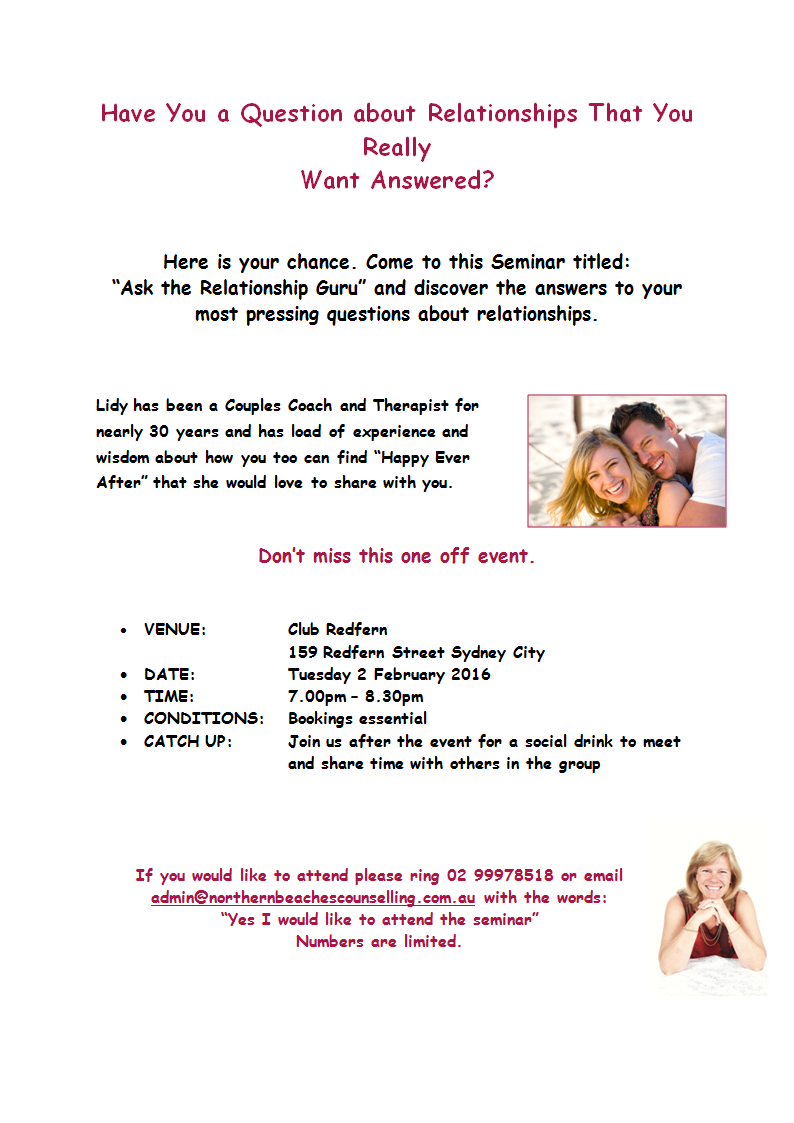
Ask the Relationship Guru

Click on the flyer to see it in full size.
If you would like to attend the seminar please ring 02 99978518 or email admin@northernbeachescounselling.com.au with the words: “Yes I would like to attend the seminar”.


Ask the Relationship Guru


Some excerpts from my workshops.

When Can We Have Sex Again? – Rediscovering Sex After Pregnancy

Rediscovering Sex after PregnancyA common question I’m asked after a couple has just had a child is: “When can we have sex again?” The short answer is: “When it feels right”. Sadly it is most often he who is ready before she is so when it doesn’t happen as he expects then this can lead to feelings of frustration and even alienation from the new mum and her baby.

Low or absent sexual desire is a very common experience after pregnancy; a reduction in sexual interest and activity, compared with pre-pregnancy levels, is really the norm during the first few months.

Studies have found that more than half of women resume intercourse at six weeks after delivery; By 24 weeks more than 80% of women were ready to be sexual again. The majority of the women even reported being able to come to orgasm by 12 weeks. And most studies indicate a gradual return to pre-pregnancy levels of sexual desire, enjoyment, and coital frequency within a year.

The return to making love is strongly influenced by the mother’s experience before pregnancy, her physiology, and her emotional and psychological make-up as well as by the culture she has been raised in.

The physical impact of giving birth is generally complete somewhere between four and six weeks. Research has shown that this differs little between those who have given birth vaginally as opposed to those who have had a cesarean birth. However the mother may still be weary for some time especially if the baby is not feeding well or is restless and taking time to settle down to a good sleep routine.

And then there is the emotional impact which may take longer to recover from. Here also every woman makes progress in her own time and in her own way.

Emotional disturbance very often takes the form of post natal depression, sometimes affectionately called, “post natal blues”. This can be as mild as feeling restless or as serious as contemplating harming the child or the mother herself.

Good old-fashioned Mother Nature is probably the greatest villain here.

While ensuring that the mother’s milk supply stays high, breastfeeding can negatively affect sexual desire whilst also guarding against a future pregnancy too soon. The reason is that estrogen levels decline during breastfeeding, which, sadly, also means that sexual interest also declines.

Vaginal lubrication also decreases which can lead to pain with intercourse which is also a way of ensuring that you don’t get into mischief while your new baby still needs so much of your attention.
The baby also makes sure that the mother’s attention is totally on her or him to ensure that this child has the best chance of surviving without having to compete with anyone else. This includes the father who, so far as this child is concerned, has fulfilled his part of the bargain.

So what does all this mean for the couple?

Firstly it means that as well as dealing with a new baby and all that entails it also means that you now have to patiently focus your energies on this child until you are not required 24/7 anymore.

In the meanwhile you can start to take any moment this child allows you to do some nice things for each other that are not necessarily going to lead to intercourse. Bathe together, massage each other, have a sleep in, if your baby will let you, and rest when your baby is asleep rather than trying to use this time to catch up on chores. Also take time out, as it is offered by friends and family, to go out and share a meal together or go to the movies.

Other forms of sexual expression, such as touching, kissing, and mutual pleasuring techniques, besides just being nice to do, can also help to re-establish physical closeness with your partner. So take your time getting to know each other again.

Whatever else you do go slowly!!

Then when the time is right, begin to reintroduce more sexually based activities into your schedule. The use of water-based vaginal lubricants can help reduce discomfort during intercourse. Vaginal moisturizer also can relieve vaginal dryness and pain.

And don’t be in too much of a hurry to get to intercourse. Masturbate each other or with each other until you are both sufficiently aroused to take it to the next step.

And don’t forget to use some form of contraception. Breastfeeding is not a guarantee against falling pregnant. And I should know as that is how I conceived my fourth child seven months after delivering my third and whilst still breast-feeding and feeling absolutely exhausted chasing after two other pre-schoolers.

Finally, take heart. Enjoyment of sexual intercourse will return, even if it is gradual, after childbirth. Give it time and enjoy the little bundle of joy you have created from your love for each other.

So until next time – Relate with Love
Relationship Remedy Signature jpeg

Is Your Partner Your Best-Friend?

Best Friends


How important is it in marriage that your partner is also your best friend?

For me the most important part of being married is that you do consider your partner to also be your best friend: There for you in good times and in bad, in sickness and in health. And who but a best friend would do that?

Maybe this could even mean that if your partner is not your best friend then they will probably not be around long as your partner either.

“I have never thought of any of my partners as best friends and have ‘separate’ best friends all along.”

I wonder when I hear a statement like this what sort of relationship this person has with their partner and how this might actually vary from their relationship with their best friend.

And while having said that, this actually might become the case in the nitty-gritty of relationships when there may be certain things that I might discuss with a best friend, sometimes even about my partner, that I would not share with my partner, as well as there being certain things I might talk with my partner about, sometimes even about my friends, that I would not share with my friends.

But when it comes to the really important things like making decisions that affects us both, or when it comes to exposing the very most vulnerable part of ourselves then your partner is fairly likely the only person who would ever see that and know about that part of you.

Can your partner be more hurtful than friends?

This is probably why it is that your partner can hurt you the most and often even more so than friends. While friends can disappoint you, in their misuse of the trust you place in them, by sharing something that was meant for them only, your partner can do much more harm by knowing what your weak spot is and by hitting you there the hardest.

And for those of you who really struggle with your relationship with your partner, even to the point of trusting your best friends more, then something is seriously wrong with your relationship that needs to be addressed if your relationship is going to make it long-term.

What is worth remembering here is that sometimes the issues that are present in your current relationship stem from your life experience growing up as you observed your own parents’ struggle with their relationship. Often fear is brought with you from those earlier experiences that lead you to distrust your partner, just as your mum or dad may have distrusted their partner. As you witness that you make decisions from what you’ve seen or heard that then becomes your guide into your own adult relationships.

So if this is you and you are struggling with your relationship: if you hesitate allowing your partner to be your best friend then maybe it’s time to take a closer look at what is really going on in this relationship.

An important Postscript

Let me just add this: there are, of course, relationships that cannot be considered in this way as they are with individuals who are abusive of you. If this is your situation then you might need to make a decision about whether you can be in this relationship at all. You may also need to make a decision for your safety that allows you to find a way out that doesn’t leave you more vulnerable to your partner’s abuse. This is a time when your friends really can become more important; as a support for you during such a difficult time. I’ll say more about this on another day.

So until next time – Relate with Love

Relationship Remedy Signature jpeg

How to Find Unconditional Love in Your Relationships?

Unconditional LoveI’ve already addressed in another article what is unconditional love but let’s review. Put simply, and as the words would imply, unconditional love is love that is given without the expectation of anything in return.

Conditional love, on the other hand, is the love that is given in response to love received and generally has attached to it something like… “I will love you as long as ….”. The conclusion to this phrase might be about something I get from you or something you do for me, so might end with “… you take care of me.” or “ … you give me what I want.”

In that article the question I was addressing was whether unconditional love actually exists. My conclusion was – ‘absolutely’ and not just in the form of a mother’s love for a child but of one person towards another whether that person is a partner, a relative, a friend, an acquaintance or just someone you pass on the street that you don’t know or might never pass by again.

So in this article I want to take this notion one step further to discuss how to find unconditional love in your relationships as they can be in all the above circumstances.

And here it is – the answer pure and simple lies in your capacity to forgive. That might be a small word but upon its shoulders lays the salvation of the world.

And here’s the most critical factor in this notion – it’s not the world that we need to focus on here but on what we do in our most private moments with those most close to us.

When I was little I was taught to admit to and then say ‘sorry’ when I committed an offence. I was told that this was the way to my salvation. I have never, and still don’t, doubt the truth of this. And while this was and still can be a hard task to complete, I have come to realize that forgiving myself and/or another may even be a harder ask. And, as I have already stated, may actually be even more important for our world’s survival.

So here is my strategy to offering forgiveness and finding unconditional love in our relationships, even if the other hasn’t asked for it, or I don’t believe that they, or I, deserve it.

The 7 Steps to Forgiveness

  1. Identify your emotions and at least express them to yourself
  2. Take responsibility for your part in the conflict
  3. Accept the other person, and yourself, as they and you are and let go of any need or want for revenge
  4. Forgive yourself as you take your learning from the situation to ensure you don’t repeat it
  5. Have the desire to express forgiveness either out loud if appropriate or at least in your mind
  6. Meet with the person involved if possible or imagine them being with you
  7. Make a connection with a past event that might have been similar and ensure that there is nothing residual there that needs forgiveness as well.

Try the exercise and if you need help with it there are more details of the exercise at my website under the heading of ‘quizzes and questionnaires’. And if you are really stuck speak with someone professionally.

So until next time – Relate with Love

Relationship Remedy Signature  jpeg

Does Unconditional Love Exist?

Unconditional Love

There’s a saying I’ve heard, and possibly even said myself, which suggests that the only love that is unconditional is the love of a mother for her newborn baby. The adage goes on to say that maybe this only lasts twenty-four hours or until your first sleepless night.

To answer this question let’s firstly look at what is ‘unconditional love’. Put simply, and as the words would imply, unconditional love is love that is given without the expectation of anything in return.

Conditional love, on the other hand, is the love that is given in response to love received and generally has attached to it something like… “I will love you as long as ….” The conclusion to this phrase might be about something I get from you or something you do for me so might end with “… you take care of me” or “… you give me what I want.”

It would be someone exceptional to truly love when nothing comes back.

Using this definition then it would be someone exceptional to truly love when nothing comes back.

Have you ever seen unconditional love? For most of you, unconditional love is probably just a fairy tale myth which doesn’t exist.  For many, love alone has become like a ghost – “everybody talks of it and only a few have seen it”. When you tell someone you love them, most of the time they will be waiting for the “what’s next”, saying there is no such thing as love so there has to be an ulterior motive for someone saying it.

However in this mean and self-centered world, you can still find those people who love, and there are many I’ve seen who truly do love unconditionally. I believe I see it everyday in parents and their children, community carers and their charges, those who offer a variety of professional help and their clients/patients and between family members of each other.

I think the ultimate qualifier here is in the willingness of one person to put themselves at risk of discomfort for the wellbeing of another.

So to answer the question in debate, I believe that love can be divided into two groups depending on its foundation. Love, that has gratitude at its roots, and love that does not spring from gratitude.

First, I will explain love that has gratitude at its roots. We might develop love towards someone because they are kind to us, may be they did us a favor, or they provided us with something, when we were in need. There can be a million reasons for loving people. Such is the love that comes from gratitude; maybe this really cannot be called love at all. Maybe it is just a deep sense of appreciation of one for another. And because there’s often a power difference here, that is someone has something, an object or a skill that the other doesn’t, such feelings and the sense of love can never really be unconditional. This is love, which has a reason.

Now, how does love spring without gratitude? Sometimes we like someone’s innocence so much that we begin to love their innocence, sometimes we fall in love with someone because of their simplicity or as I have already alluded to it is simply that of one person for another without any expectation of reciprocation.

Therefore, yes unconditional love does exist, but maybe is far too rare. The most notable thing about unconditional love is that it has no explanations, no reasons, no apologies and no gratitude. You just love, love and love, because you love. There is no reason for your love. Hence it is called unconditional love.

In another article I’ll speak about how you can find unconditional love in your relationships.

So until next time – Relate with Love

Relationship Remedy Signature jpeg

Is Marriage Going Out Of Style?

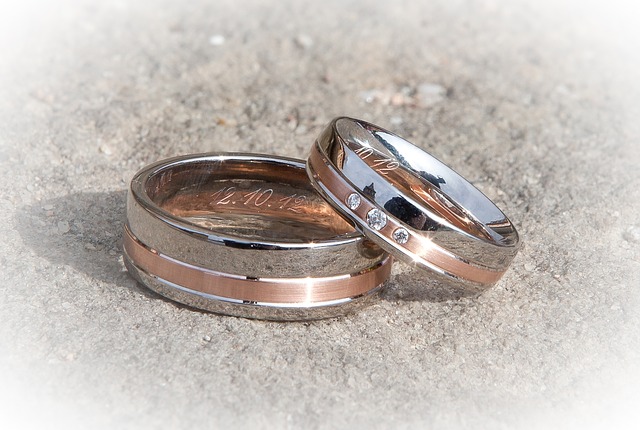
rings

You may already know that I have four children, all adults, who are starting to look at entering into long term relationships now that their childhood has passed them by.

Accordingly two of my sons have now ‘tied the knot’ having done so in the last couple of weeks and it left me with the question: Is getting married still the ultimate goal for this generation or is it, as I was believing, going out of style?

My thinking was that this generation, probably more than any other in history has been witness to their mother and father’s liberation as a consequence of the changes in family law that has happened, in Australia at least, during the 1970’s. The new laws allowed for ‘no fault’ divorce and as a consequence there was a rapid rise in divorces for the rest of that decade.

Up until that time for a couple to divorce it needed to be for a reason. This often led to couples creating reasons or one or other of the couple ‘taking the heat’, so to speak, in order for there to be good grounds for divorce. In this regard they would accept an allegation of adultery in order to get the application accepted by the court.

This certainly was not fair or honest and left many couples, and families, in distress as a consequence.

‘Happy Ever After’

So my belief was that possibly this situation tainted our children’s view of marriage and the notion of ‘happy ever after’.

But maybe not so! As I chatted with the guests at my children’s weddings, I was curious about this and so asked several young people the question. The responses, I must say, surprised and delighted me as I was challenged to put aside my own preconceptions and cynicisms about whether young adults today thought differently about marriage than my generation might.

Following my conversations with many of these young people I was astonished to hear that not only did they believe in ‘happy ever after’ but wanted to seal it in their marriage vows.

Not only that but I also discovered a refreshing interest in this generation of wanting to learn the skills necessary to make their relationships work with a strong commitment to that as an outcome.

I was so happy to hear that, especially in terms of where my work is now taking me, being into the area of pre-marital coaching.

Let me then invite all of you, whether you are going into a marriage or are already in one, and who wants to make your relationship the best it can be to head on over to my website and check out the quizzes page. There you’ll find a questionnaire titled ‘Are you ready to be in a relationship?’ It’s free! Complete it and let me know how you went.

Pre-marriage Program

If you want to extend yourself further check out this page: ‘Pre-marriage Program’ where you’ll be introduced to an in-depth analysis of your relationship and an answer to your question about whether you have what it takes to make your relationship last your lifetime.

Interesting – the one thing I didn’t hear my children say to their new spouses was that they would be there ‘til death do them part. I think this was as it should be as I don’t think its right to promise something for some time in the future when we really don’t know what that future will be or how we will be in it. I’ll say more about that in another blog.

So until next time – Relate with Love

Relationship Remedy Signature jpeg