Indicators That Your Relationship Is In Deep Trouble

Nine Indicators That Your Relationship Is In Deep Trouble


Child Marriage my school bag Low-income area Bulbul near Nairobi, Kenya (10543163816) Grace Cathedral Interfaith Chapel - altar with many faith symbols Contempt

Why Do My Parents Hate Each Other So Much?

I was speaking to a young boy this week, let’s call him Mat (not his real name), who asked me a question about his divorcing parents – “Why do my parents hate each other so much?”

I found myself searching for an answer and finally said: “I don’t believe your parents really ‘hate’ each other but maybe are just so angry with each other, and with the situation they are in, that it looks like they really hate each other.”

I went on further to explain my belief that in order for a couple to actually go through the process of divorcing from each other they also must go through what seems like ‘hate’ before they can really do it.

Mat then asked me: “So how did they get into that position in the first place?” The only way I know how to answer this is to believe that one ore more of a set of factors became evident and ultimately became more stressful than the good that existed between the couple. When this reaches that point of being unbearable then the relationship blows out and separation and/or divorce become thereby inevitable.

John Gottman, an eminent Couples Researcher discovered after studying the incident of divorce for more than thirty years came up with a set of predictors that measure whether a couple is potentially at risk of divorce. Here they are:

  1. Did you marry at an early age?
  2. Did you not graduate from high school?
  3. Are you in a low-income bracket?
  4. Are you in an interfaith marriage?
  5. Did your parents divorce?
  6. Do you criticize one another?
  7. Is there a lot of defensiveness in your marriage?
  8. Do you tend to withdraw from one another?
  9. Do you feel contempt for one another?

If you answered “yes” to most of these questions, then you are statistically at a higher risk for divorce than couples who have reasonable expectations of one another and their marriage, communicate well, use conflict resolution skills, and are compatible with one another.

So this is not to say that if you answered “yes” to any one of these question you are going to divorce. What it does mean is that you have got some working out to do to ensure that you do not go that route.

And here’s the really good news: knowing the areas that leaves you in risk of divorcing means that you know what areas you most need to work with. The time is now to find a well qualified therapist to help you resolve these issues before they destroy your relationship.

And as for Mat’s parents? The issues that I suspect are current for them are more to do with how they have related to each other rather than anything to do with cultural, education or financial issues. They are very critical of each other, withdraw regularly, and I think the ‘hate’ that Mat is observing has actually now become contempt for each other as they continue to separate themselves further and further. It’s like they are on a downward spiral and are unable to stop what is happening.

So until next time – Relate with Love

Relationship Remedy Signature jpeg

Love is Being Able to Say – “I’m Sorry!”

Sorry honey!

“Sorry” – this simple five letter word can work magic. And while it is sometimes the hardest word to say, it can change so many things; the way people think about us, and even how much they care for us as well as how close to us they feel.

Even after knowing the magic this word can do, there are certain times when we do not want to say – “I’m Sorry”. Sometime our ego stops us from saying sorry. We can feel like if we would say sorry, we would lose our value.

This is not to say that you should just say sorry every time something comes up for you and your partner. The really important thing to remember here is that it takes two to make a relationship and two to break it. Therefore, no matter what the situation is, there is going to be fault on both parts.

The task here then is to figure out what part of the issue is yours and what your responsibility is to that and to be willing to say sorry for that regardless of whether the other person is willing to take responsibility for their part and/or is willing to say sorry for that or not.

If you feel that you should be saying sorry but are not able to then there is some other issue that may be stopping you which may need to be explored first.

I strongly agree with the statement often said that, “in a relationship you should not hesitate to say sorry even if it is their mistake”.

The important thing to remember here is really about what are you saying sorry for and to express that to yourself and your partner. Your partner then will be compelled to look at their part in the issue and will then make up their own minds. They may then, or may not, say that they are equally sorry for their part.

Keep in mind though that whether they say sorry or not should not be what makes you decide to say it. Your sorry should be offered openly and honestly, without condition or expectation of something coming back.

Finding A Way from Being Mad To Saying Sorry Test:

There is a simple “saying sorry test” you can take to discover if you are ready to say sorry or not.

Answer each of the following questions as honestly as possible. It may even be helpful to write down your answers:

1 What is the truth about the issue? It can still only be your perspective, and your partner will have their own perspective, but somewhere in that you should be able to find a way to trace the events that led to the issue and ascertain your part in that.
2 What does the other person in the event mean to you? If they are very important to you and you think that losing them would be a great loss for you, then do not hesitate to initiate the apology. Even if you think the mistake is theirs remember that you are a part of it and can take responsibility for that.
3 What do you mean to them? Do they really love you? Are you willing to let a potentially unresolved issue get in the way of your long-term relationship? The truth here is that any issue left unresolved will not go away on its own; it will become an irritant until one day it finds a way out through via some other issue.

If in answering these questions you are able to get clear about what there is to be sorry about, don’t hesitate to express it. Even if you conclude from this that it really isn’t for you to say sorry you should be able to at least say sorry for the difficult situation you both find yourselves in.

From sorry then comes forgiveness and I’ll address this concept further in another article.

So until next time – Relate with Love

Relationship Remedy Signature jpeg

Are You Marriage/Relationship Ready?

Untitled


This week I attended two days training on the topic of preparing couples for marriage/relationship. We had some lengthy discussions about what the benefits of this might be for couples and who would want it.

With this in mind I thought this would be a good time to address my thoughts on the topic and I’ll speak more about the service at the end of this article/blog.

Reduce Your Likelihood of Divorce by 30%

Research has shown us that the divorce rate of those who have done a preparation for marriage course cuts the divorce rate by more than thirty percent.

Every couple hopes that they’ll live happily ever after. Fewer than one in three actually will. What makes the difference? Is it love? Is it luck?

Did you know that most affairs and divorces occur during the years just after the wedding? That living together before the wedding does not increase marriage success? That marriage satisfaction can plummet when a child is born?

Transition from the romance of the pre-wedding period to married life can be much more challenging than most couples expect.

Premarriage preparation, or premarital counseling, is a form of counseling that can benefit every couple planning to marry or enter into a long-term relationship. This is not the same as couple therapy, which may be what’s needed when more critical issues come up. Premarital counseling tends to take on more of an educational role. Its purpose is to help you discover things about each other that you may not have known before giving you an opportunity to confirm for yourself that this person really is the right person for you.

Premarital counseling is also about teaching you the skills you will need to support each other in having a happy and lasting marriage.

So, just like life, the marriage certificate doesn’t come with a set of operating instructions. And, just like life, the skills you need to make a successful relationship aren’t necessarily learned from observing your parents. The truth is that most of them may also still be trying to figure out how to be in marriage/relationship. The skills really are best taught by someone trained who has the knowledge of what it takes to be a couple.

The philosophy behind premarital counseling is that it highlights the strengths of a couple before you marry and to anticipate and prepare you for the challenges and conflicts that could arise in the future by drawing attention to your growth areas.

Premarital counseling will help you identify and communicate your fears, desires, beliefs, values, dreams, needs, and other issues that may have been previously avoided or denied or maybe even never discussed.

Research into the benefits of premarital counseling has found that there is a window of opportunity that exists during the year that precedes the wedding as well as the first six months after the wedding when the most benefits from premarital counselling can be gleaned. As time passes and more stress comes into the relationship, a couple can find that negative habits and unhealthy relationship patterns can develop that can become well established and very hard to break.

Research has illuminated seven areas of knowledge and relationship skills that help contribute to the development, success and lasting quality of a happy, loving marriage.

Planning a wonderful wedding is great, but investing just a little in the success of your marriage and long-term relationship is at least as important.

Anyway let me get back to the training day. The workshop was teaching us, the participants, how to use a software program called “Prepare-Enrich”. We further learned how to read the results, facilitate a feedback session and to discuss with the couple any issues that became evident from those results.

This program begins with having each member of the couple complete a very detailed inventory. While this was developed back in the 1970’s by David Olson Ph.D., as a paper and pen exercise, it is now completed on the computer in your own time. The inventory is designed specifically for your situation based on the details you enter into the computer in the first instance.

The intention of the program is to help build stronger relationships through the following avenues:

  • Explore Strength and Growth Areas
  • Strengthen Communication Skills
  • Identify and Manage Major Stressors
  • Resolve Conflicts using the Ten Step Model
  • Develop a more balanced relationship using the Couple and Family Maps
  • Understand personality differences and maximize teamwork

The follow-up sessions address every one of these areas in order to be of the greatest help to couples.

I’m feeling very excited about being involved in the great work that David Olson and others are doing and would like to offer my readers an opportunity to complete the program as well.

If you would like some more information about this program contact me or check back at my website. We would be happy to help you complete the inventory.

So until next time – Relate with Love
Relationship Remedy Signature jpeg

Managing Long Distance Relationships

Long Distance Relationship

What is a long distance relationship?

I’m often asked about how to best manage long distance relationships.

Firstly let me try to define what a long distance relationship is. In this article/blog I’m going to define it as any relationship wherein the couple are not living together.

So by this definition it could be any relationship where one person resides elsewhere other than in the same house as the other person in the relationship. These separate residences could be across town or even across the world.

It could be as a consequence of one party having work commitments that means they need to live elsewhere, such as in the armed services or just by being a shift worker. This could even be as a consequence of one of the parties having been imprisoned. Or it could be that the situation they are in doesn’t allow the couple to live together; one party may already be in a relationship, or the relationship is not accepted culturally because of church or possible criticism from the rest of the community such as might be the case with same-sex couples.

There is also the possibility that the marriage has been arranged and due to cultural practices the couple are not able to meet until they have married.

And of course there are relationships that exist only across the internet – cyber relationships. These relationships can be just as intense as any relationship conducted face-to-face and even have the capacity to become sexual in their own way.

So how do couples manage these relationships?

Well firstly there is no doubt that these relationships can be more difficult to manage as each of the couple go about living their own lives. Having to make time to be with each other, however that happens, can be a difficult and challenging task.

There are also the challenges associated with sharing these relationships with other people in the life of the couple such as family, friends and work colleagues.

I’m also drawn here to think of situations where one party is in a totally foreign environment such as a prison or a war zone. The reality here is that the person who is living in a more “normal” environment really is not able to know exactly what the experience of the other’s life actually feels like for them and can only rely on their communication to even get any glimpse at all.

And yet with all of these things against them, couples still find a way to have and to maintain these long distance relationships. And the answer as to how they do it is not as difficult as it might seem.

The success of these relationships comes from an absolute and unparalleled commitment to each other and a total trust in the commitment of the other as well.

And just as with any relationship that makes the distance, if you’ll pardon the pun, it still requires lots and lots of ongoing conversations about how it’s going for you as well as an ongoing interest and curiosity in the day by day happenings in each others lives.

I would love to hear back from any of you in these kinds of relationships to speak about how it is for you and how you keep the love alive.

So until next time – Relate with Love

Relationship Remedy Signature jpeg

Is Your Relationship in Trouble?

Don’t make any rash decisions until you have booked yourself in to this seminar.

“Lidy has helped thousands of relationships. Maybe she can help yours as well.”

In just 90 mins you will learn the 3 simple steps you need to take to get your partner to understand how serious things have become. The seminar will give you strategies that you can immediately put into practice to:

  1. Understand the problems couples are dealing with
  2. Determine the extent of your Circle of Control and Influence
  3. Communicate a message that you can be sure will get heard
Recharge Your Relationship

Walk out of this seminar with a plan to recharge your relationship.

  • VENUE: Club Redfern, 159 Redfern Street, Redfern
  • DATE: Tuesday 1 September 2015
  • TIME: 7.00 pm – 9.00 pm
  • COST: $10.00 for you and your partner or friend
  • CONDITIONS: Bookings essential

If you would like to attend please ring 02 99978518 or email lidyseysener@optusnet.com.au with the words:  “Yes I would like to attend the seminar”

Numbers are limited.

One lucky person will also win a FREE copy of my soon to be bestseller and for anyone who purchases a copy you will receive a beautiful gift as well:

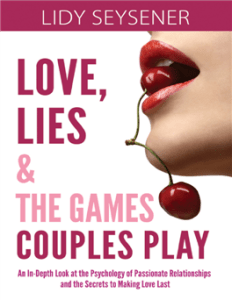
Book Cover “Love, Lies & the Games Couples Play” valued at $27.95

How to Talk About Money

Talk About Money

Conflicts over money can fatally damage your relationships. In surveys with couple’s money even ranks as one of the biggest reasons why married couples fight and can even be the catalyst for couples separating.

For many of us today, just covering the costs of the basics has become a struggle. We are fighting about an array of things including rising fuel prices, higher cost of groceries, never-ending charges for the kids’ school supplies and those mortgage costs that continue to go up.

This stress can cause all of us in relationships to boil over as we look to one another to blame for the problems. Oftentimes, these stressors cause us to bring up financial, as well as other, “sins of the past”.

The way to deal with the stress around money is to talk about it. Most of us avoid this conversation at all costs. Why? Because the very act of raising the topic involves stress! Most of us would rather just avoid the conversation altogether and hope it will somehow magically all get better. But guess what? It won’t get better; and will continue to get worse unless you deal with it.

Three Steps to Having the Money Conversation:

  1. Do a Reality Check

Firstly realize that delaying this conversation will result in more pain later. Money problems do not go away by themselves. If you put off having these important conversations with your partner they’ll only get worse. If you’re getting deeper and deeper in debt each month, then every month that goes by just means even more debt. You must make a decision that you will initiate this crucial conversation about money now so that you can actually have less pain later.

Ask for a calm and honest conversation with your partner about money. This conversation should be initiated from a sincere concern about your direction as a couple. Your partner should not be made to feel like they are being cross-examined. Otherwise, they will be on the defensive before the conversation even begins.

Expect to share all your “spending secrets” with your partner. Most often we see all the financial failings of others, but we conveniently forget about our own. Your conversation about money has the potential to either create a strong bond in your relationship or drive a wedge between you. It all depends on how you handle the conversation. You must both be completely honest.

  1. Accept Responsibility

A very important aspect of this conversation must be the willingness on both of your parts to accept full responsibly for where you are. This means to accept full blame for all of the things that each of you did that may have caused the current situation and to accept responsibility for the actions you both need to take to remedy it.

This conversation can be challenging and painful. But it can also be rewarding and profitable. You might even see your relationship begin to change for the better once you deal with the underlying negative thoughts and emotions.

Begin this conversation with a spirit of openness. If you set the tone in the beginning of this conversation with a positive attitude and approach, things should go much better. And regardless of the issues that must be discussed, mutual respect is very important for continuing to build a healthy relationship.

  1. Moving On

At some point, both of you may need to “agree to disagree” over something from the past and move on. Being the bigger person can save you frustration and further future financial problems.

It might be helpful for you and your partner to schedule regular “money meetings” and to even establish a budget for you both to follow. You may even begin to make some progress in your financial life as you have these talks more often and begin to really control your finances with a clear plan in place. It might even open the way for you to talk about other important issues again or maybe even for the first time.

While showing respect, you may have to address serious spending problems and other issues. The key here is to focus on resetting where you are heading. Money problems created in the past cannot be erased, but you can start over with a new plan for the future.

So until next time – Relate with Love

Relationship Remedy Signature  jpeg

How Do I Know … ?

Kiss

Many of you are asking ‘how to …’ questions so in this week’s article/blog I have selected ten of the most common ‘how to’s …’ to answer. These are just my thoughts so do go to the comments link and add your own.

  1. How Do I Know he/she Loves Me?
  2. How Can I please Him?
  3. How Do I know he means it?
  4. How can I make him happy?
  5. How do I know what women want most in a relationship?
  6. How do I prove I love her?
  7. How do I let her know I love her?
  8. How do I know it will last forever?
  9. How do I show him I love him?
  10. How do I know if I can trust her?

The song written by Rudy Clark in 1964, and made famous by Cher in 1991, titled ‘It’s In His Kiss’ may answer some of these questions. Here are the lyrics:

Does he love me?
I wanna know!
How can I tell if he loves me so?

(Is it in his eyes?)
Oh no! You need to see!
(Is it in his size?)
Oh no! You make-believe!
If you wanna know
If he loves you so
It’s in his kiss!
(That’s where it is!)

(Oh yeah! Or is it in his face?)
No girls! It’s just his charms!
(In his warm embrace?)
No girls! That’s just his arms!
If you wanna know
If he loves you so
It’s in his kiss!
(That’s where it is!)
Yeah!! It’s in his kiss!
(That’s where it is!)

Oh, oh, oh, honey!
Squeeze him tight!
Find out what you wanna know!
Promise love, and if it really is,
It’s there in his kiss! …

Is it really in his kiss, or in his eyes or face or arms? Or is it in none of these? Does this song really sum it all up or is there more to it?

Well, I think there is a whole lot more to it. And if you think the answers are to be found anywhere outside of the relationship, I think that you might also be looking in the wrong place.

So if the answers are not in their kiss, and not out there, where are they?

I’ll answer that question in a moment. Let me firstly say this: What these kinds of questions echo for me is that either you’re not asking the right questions or you just don’t trust yourself, or your intuition, enough to believe that what you’re hearing is the truth, or that they are actually lies.

Or maybe you’re just not asking any questions at all out of fear of what you’ll hear or worse, that you might get an outright rejection. Maybe this is because you’re not yet sure enough about your own love; either of the other or of yourself or do not have an absolute belief that you are worthy of love. What happens then instead is that you try to guess what’s really going on or hope that someone else may be able to help with the answers.

Maybe the issue here is really about trust: Trust of yourself to know the truth when you hear it and/or trust of the other to believe that what they are saying will answer your questions truthfully.

So where do you find the answer to these questions? Ask the person who really should be answering them. The truth really is there, and is plain to see when you open yourself to it. Be brave – ask the questions you really want to know the answers to and trust that he or she will answer you honestly. Then look into your own heart to determine if the response actually is the truth: If it is you’ll know it. If it’s not or you still are not sure maybe this person is not the one you should commit yourself to.

If, after getting the answers to your questions you feel sure about the answers then kiss him or her often and take the time to make it heartfelt. Show him or her through your kiss that you truly love them. The only question I have for you then is ‘how could they not love you forever?’

So until next time – Relate with Love
Relationship Remedy Signature  jpeg

Should I Marry Or Just Live With My Partner?

Should I Marry Or Just Live With My Partner

I receive countless emails on the topic of getting married versus living with your partner with the possibility of one day getting married and all the apprehension that goes with that decision. So in this article/blog I’m going to address these questions as I understand them and welcome your comments as well.

I also receive many questions about arranged marriages, and the consequences of that on the couple, as well as about marriages that are not arranged and do not have the approval of family.

Here are a couple of scenarios:

  1. Boy meets girl – they fall in love – they commit to each other and set up house either with a view to getting married or having just done so.
  2. Families introduce the couple – they live with their own families until they get married often not even meeting, or if so briefly in the parents company, before their wedding day.

Researchers have looked into each of these scenarios, amongst others, to determine what situations give the best long-term outcomes for couples.

And here is what the research is indicating:

Generally over the long-term arranged marriages have the highest rate of success. That is not necessarily to say that these couples are the happiest but, due to the cultural structure of their communities, where women particularly often have less input into their life decisions, the permanence of these relationships is pretty much guaranteed.

Another indicator coming from the research is that marriages that have resulted from a courtship whereby the couple has lived separately until their wedding day also seem to have a higher success rate than couples who have lived together prior to becoming married.

The lowest long-term success rate comes from couples who live together before they marry or who live together without marrying at all or who have only known each other for a short period of time before marrying.

My hunch is that there is a common denominator here that is to do with commitment. This commitment however could be self-directed or other directed. In the case of an arranged marriage there may be a commitment based on lack of perceived choice. While on the other end of the continuum, the couple who live together without making a long-term commitment, may actually not have given enough thought to the decision and consequently may feel more able to step away from the relationship if things get too hard.

This is a huge generalisation based on a set of figures which of course is just that; numbers not real people.

I look forward to your stories to tell me of outcomes that are contrary to the research results, for good and for bad, and maybe we can conduct our own research to see what structure relationships take that have the best outcome.

There is another set of figures being published too that says that second marriages have a higher failure rate than first marriages. This is often blamed on the additional stress of there now being children in the relationship or that someone has not learned their lessons from the first relationship and thereby just gets into the same negative place again.

And in terms of going against statistical norms I will be the first to hold up my hand. I met my current partner just as I was ready to end my previous relationship. I don’t mind saying that while we have never married we have now been together for twenty plus years and each year just gets better and better.

So what does all this tell us? Simply this: there is no best way to choose a partner or to choose a type of relationship or even a best time to marry. This might also mean then that there is no optimum time to know each other before committing to a relationship nor a best age to do this.

The most important thing is that you love each other and respect each other and treat each other as if you are the most valuable thing in the world. This presupposes that each of you is at peace within yourself. Sometimes this means making it more about your partner than about you. If you can do this then whatever arrangement you have will work.

A Word of Warning

A really important thing to remember is that relationships can be fragile and need regular nurturing and care. Don’t ever treat another person as someone to own or to have control over or to force into a relationship without their want. This is not respectful or favourable to being loved.

So until next time – Relate with Love

Relationship Remedy Signature  jpeg

Your Biggest Relationship Questions Answered

Your Biggest Relationship Questions Answered: a special 1 hour Q&A Webinar with

Your Biggest Relationship Questions Answered with Lidy Seysener and Frank Fava Your Biggest Relationship Questions Answered with Lidy Seysener and Frank Fava

Lidy Seysener

Frank Fava

Hi

A Colleague of mine Frank Fava and I are going to be presenting a webinar together next week so this is an invitation to join us and hear the two of us answer all your relationship questions, or as many as we can fit into an hour.

The topic for the event is “The Biggest Questions You Have About Relationships”.

For those who don’t know what a Webinar (Web-based Seminar) is it is an event that happens online where you will hear, in this one at least, Frank and I answering questions on what it means to be in a relationship in 2015. It is also an event where you can post (ie write down) questions as we go for us to answer.

This is the first time we’ve done this kind of event so I’m going to be learning as well.

The place to register your interest in this webinar is:

http://relationshipsrevealed.com.au/qa/

There you will find this introduction:

Introducing Lidy Seysener of Northern Beaches Counselling.
I have the privilege of having Lidy as a guest speaker and expert on a special 1 hour Q&A Webinar.
Change yourself and you change your relationship.
We’re going to be answering your biggest questions on being your best self in relationships and getting “Relationship Prepared”.
If you can’t join us LIVE: Register anyway, and I will send you the Recording of the session the following day.
See you there!
Frank Fava
Relationships Revealed

So just click on the link and RSVP directly there and I’ll look forward to answering your biggest questions about relationships then.

If you have any questions about this webinar feel free to reply and I’ll try to answer them.

Regards

Lidy

Is It Possible to Make an Affair Work for You?

Is It Possible to Make an Affair Work for You

One of the most hurtful events of a relationship is when someone is discovered having an affair.

Generally one of three things happens when someone discovers that their spouse has been cheating on them.

  1. The affair is ignored. This may mean that the affair continues but nothing changes in the relationship. This is often because the party being cheated on just doesn’t want to ‘rock the boat’ for fear of what might come of it.
  2. The relationship ends. Sometimes one or other of the couple decides that they can no longer be in the relationship and so the relationship ends.
  3. Ideally the affair stops. The old relationship discontinues and a new relationship begins.

Whether the relationship ends or not, some serious losses will be experienced. Losses can be physical or symbolic and may include:

  • Loss of trust
  • Loss of security
  • Loss of hope/dreams
  • Loss of faith
  • Loss of intimacy and affection
  • Loss of self-esteem

Sometimes it is these losses, over and above the affair, that pulls the couple apart and sounds the death knell for continuing the relationship.

If the third option is the case the challenge then is for the non-offending spouse to overcome these losses and find trust again for the other person. This is probably the biggest hurdle to overcome.

The Way Forward

The way forward then is to take the time with your spouse to talk about all these issues and to realign them with a new way of being.  More than anything for a relationship to make it through there needs to be forgiveness: forgiveness of each spouse of themselves and of each other for the part they played in the affair.

And yes, as hard it sounds, even the non-offending spouse might need to look at their part in causing the affair. In saying this I don’t mean to imply that the offending party should be absolved of what they have done. They must take full responsibility for the hurt they’ve caused but, as I’ve said before, the reason this affair has happened is because there was something amiss in the relationship to start with. For this both spouses need to assume responsibility.

To help you both along the way it might be useful to start a journal. Express all your thoughts and feelings in this journal; the good, the bad and the downright ugly. And besides making the time to talk about what happened there might also need to be some new, if only temporary, rules put into place regarding letting each other know where you are and what you’re doing and how long that will be. This can be the only way forward if trust is going to be re-established.

And by the way the spouse who decides the ultimate outcome of the affair will be the non-offending spouse not the one who cheated. Your role is to just grin and bear it, as this is the consequence of having erred. If there is enough love and a renewed commitment and trust you will find a way to reconnect. For both of you don’t be in a hurry. It will take as long as it takes.

Sometimes all this might seem too hard to do on your own and you might need some professional help. Take that help even if you don’t yet know what you should do now that the affair has been exposed. Counselling will help you find your way through the mess to then be able to make a clear decision to either leave the relationship or to recommit. It’s only as you come to make this decision that you can start to move forward.

So until next time – Relate with Love

Relationship Remedy Signature  jpeg