Tag Archive | Love

What Is Marriage?

What Is Marriage

I loved receiving this question as it’s something that we may expect that we all understand but in truth maybe we actually don’t.

So I started my research into answering this question by scrambling to the Macquarie Dictionary which defines marriage as “the legal union of a man and a woman for life including a legal or religious ceremony.”

This definition really doesn’t give us very much at all as marriage today in so many cultures, legally and through the various churches, is open to being dissolved on the wish of one or other of the parties. In most countries these divorces are even permitted without even having to prove that one party is in some way more at fault than the other.

So I thought that I should proceed in this article to discuss my thoughts on what marriage is and would welcome you to add your thoughts on the topic as well.

While marriage may relate to a legal process for me marriage is more about the commitment two people make to be there for each other come what may. I would also expand on the dictionary definition to include not just the communion of a man to a woman but also of either a man or a woman to another man or woman.  In my view they are as much a marriage as any marriage could be.

The sad thing here is that too many people enter into a marriage without really knowing what they are getting themselves into or without going through any preparation to ensure that their marriage will go the distance.

When I work with couples contemplating marriage the first thing I get them to consider and discuss with each other is this very question: what is marriage to each of them? How do they define it and are they ok with how their partner defines it or does it need some tweaking to make it something that both of the couple can live with.

As most of you might know I am in a relationship and have been for more than 20 years. My partner and I are not married nevertheless I describe him as my husband and wear his ring. He also describes me as his wife. It actually took us some time to acknowledge each other in this way as we were assessing our future together especially as I had four young children already as part of the package.

One of the first things we discussed in terms of our marriage was about whether we would live together and where that would be. We then had many conversations about how we would manage my children and whether we would have any more children. We then had to decide on the division of responsibilities both in terms of household chores and financial contributions. Finally we had some conversations about ownership of property and what would happen in the event that either of us predeceased the other.

And while this was not an issue for us as we are both of the same religious beliefs, for many couples there is also the question of what their particular religious beliefs are and how they might impact on their relationship and/or to any children of the relationship.

So while some of these issues are still conversations in progress for my partner and myself, the underlying promise is that we will be there exclusively for each other for the rest of our lives. In this we committed to never walk out on the other and to always raise it whenever we had an issue that affected us both and/or our future together.

This is how I define my marriage for me. It is a safe place to collapse into at the end of each busy day where I can feel safe and not be judged negatively no matter what I do or think. It is a place where I feel loved unconditionally and love in the same way.

So until next time – Relate with Love

Relationship Remedy Signature  jpeg

Seminar February 10, 2015

Click on the flyer to see it in full size.
If you would like to attend please ring 02 99978518 or email admin@northernbeachescounselling.com.au with the words: “Yes I would like to attend the seminar”.


Seminar February 2015


Some excerpts from my workshops.

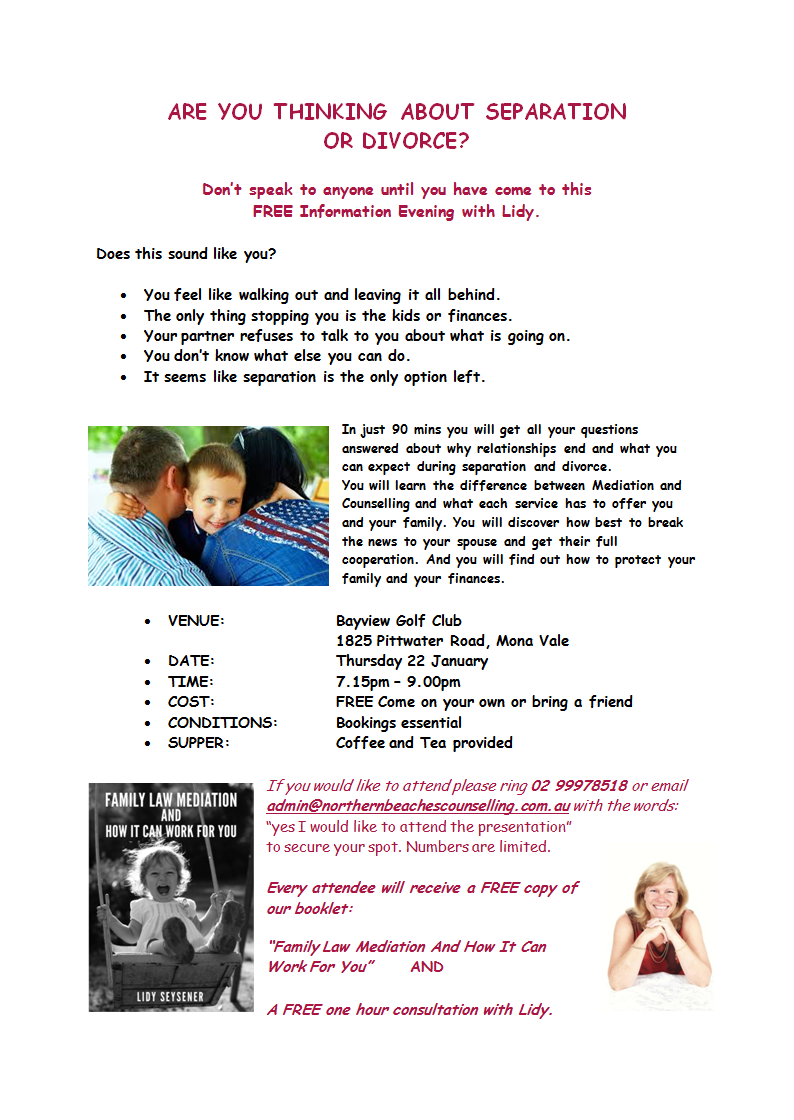
Sex, Lies and the Truth

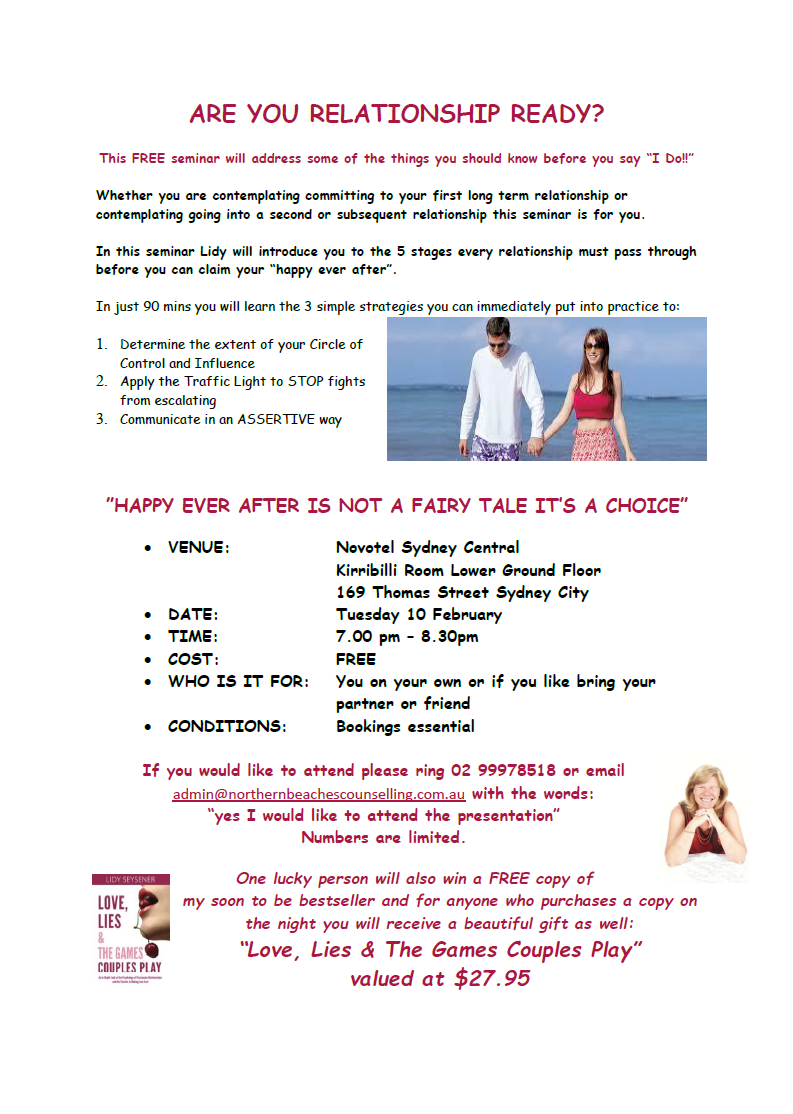
Broken Heart

Is it possible for someone to truly love you and hurt you over and over with lies and deceit?

What a great question this is to get me going for the week

The short answer is this:  NO! Someone cannot truly love you and hurt you over and over with lies and deceit. But it may be a little more complicated than that.

Lying and deceitfulness can be a natural response to being constantly tormented, fear of being found out, or from the modelling we get from the most important people around us, generally our parents.

There are also gradients of lies. There are the lies of omission when we don’t tell someone that what they are wearing doesn’t go with whatever, their body shape, the occasion etc.

On the other end of the continuum are the really big lies that have a huge impact on people’s lives, individuals or whole countries, which can and do change the course of history.

My curiosity is pricked when I hear that someone is being deceitful in their relationship. Is this a cold-hearted act of cruelty with no regard for the impact the lie has on another or is it something much more than that?

My belief is that lying is a complex issue that really needs to be viewed not just in the context of the current event but in the context of a whole lifetime of experience.

When we are very young we learn to tell lies as part of socialising us to the norms of society. So we are taught to hold our tongues when we get crushed under the hug of our big, fat aunties and respectfully say ‘thank you’ for the gift that we really didn’t want. We also learn in the process that lying can protect us from being punished, sometimes in very, even too harsh ways. Lying can even become habitual as a way of avoiding the anger of someone in a position of authority over us as well as a means of avoiding the feelings of fear that can go with that.

As an adult we normally grow out of this behaviour as we meet with other adults face to face, in truth and in good will, to manage our conflicts in an adult way no longer needing to resort to old patterns of behaviour. Sometimes however old behaviours are so entrenched that the habit has become hard to shift. Alternatively the person is triggered to feel the same sort of fear they experienced as a child and respond from an internal child part of themselves rather than an external adult part.

In these situations the lies and deceit are not intended to hurt but become the habitual response of someone who doesn’t yet have the skills to manage themselves in a more mature way.

So to come back to the question at the beginning of this article

Love is a mature adult feeling that is pure and clean with no unresolved issues attached to it. So to truly love another implies that you are fully there with this person in the most vulnerable way possible. This means that your heart, soul and body are open and exposed without any defences. So to put it more simply, love and lying simply cannot be present in the same moment.

While we are humans, and we will slip up, for us to be truly in love with another requires us also to be truly honest. If we cannot be truly honest then we can’t possibly truly love because instead of being there fully in the present we are being held back by something from our past that will need resolution.

So if you are being lied to and hurt constantly by your partner and they are unable, or unwilling, to do what it takes to change then you really do need to think about the long-term viability of your relationship.

So until next time – Relate with Love
Relationship Remedy Signature  jpeg

He Has Never Said “I Love You”

Daisy and HeartThis email came through to my desk last week and it left me feeling very concerned for the young person who sent it. It said:

“I’ve been in a relationship with my boyfriend for two and a half months. We are engaged to be married early next year however I’ve some doubts about him. This is because everybody thinks he loves me except for myself. He has never said “i love you” throughout this period; not even once! I don’t feel loved enough and yet am scared to walk away. Do you think our marriage will work?”

In answering this email I will presume that this person actually has a choice in the matter as to who she marries as this email came from a non-western country. And as I have only a small part of the story I will answer it on the basis that I may be making a few assumptions.

There are a couple of issues being raised in this email. Firstly is the fact that this person has never heard her boyfriend say he loves her. Does this actually mean that he does not love you or that he doesn’t know how to say “I love you!”?

If he has never had it said to him by a parent or significant other as he was growing up then he might not be able to say it. Alternatively if he has grown up without love then he may not know what it feels like to be loved or to love someone else. In this regard he may not know that it could actually be safe to love someone and not be let down or disappointed by that person to whom he may have bared a very vulnerable part of himself.

Of course it may simply be that he does not love you and if that is the case then you should think very carefully about committing yourself to this man on a long-term basis. And as for everyone else thinking that he loves you; what do they base this opinion on? Has he said something to them that he is not willing to share with you? Or are they basing this conclusion on his behaviour and how he treats you?

The other issue that this email raises is whether such a relationship, where people don’t, or can’t speak their truth about love, can actually work. My thought on this is that no marriage can work if both parties aren’t willing to trust the other with their love and with their soul which involves the deepest and most profound parts of themselves.

When you don’t feel loved

Despite all of this the most telling part of this email is reflected in the statement “i don’t feel loved enough and yet am scared to walk away.” My only response to this is; if you don’t feel loved enough at the beginning of your relationship don’t expect to be loved enough later on. I’d like to qualify this by saying that as a relationship continues, and as you come to know each other better, the love generally becomes deeper and more heartfelt.

But this doesn’t just happen. It is the consequence of an open and expressed love that comes from the care a couple shows to each other over time. It could even seem that if that person were to go away that it would feel like having a limb removed as they are such a fundamental part of your own being.

I would also like to ask this person what it is you fear that prevents you from walking away. If you feel that there may not be someone else for you, there is. In actual fact there are probably millions of people around the world that you could be compatible with and with whom you could make a great relationship. If you fear your friends or families judgement remind them that this is your life to live and that you must make your own choices. If it is that you fear him or his retribution then you need to remove yourself immediately from this toxic environment.

Finally let me add one more point. You have only known this person for such a short time before making your marriage plans. Take the time to get to know each other. I don’t have a belief that there is a particular time frame you should be together before getting married but two months, especially when there are doubts, may not really be long enough to come to know anyone well enough to commit to them for the rest of your life.

So until next time – Relate with Love
Relationship Remedy Signature  jpeg

Presentation January 22, 2015

Click on the flyer to see it in full size.
If you would like to attend please ring 02 99978518 or email admin@northernbeachescounselling.com.au with the words: “Yes I would like to attend the presentation”.


Presentation January 22, 2015

Some excerpts from my workshops.

Ten Reasons Why Someone Might Be Unfaithful and What to Do About It

Blatent Cheating

Betrayed By A Fiancé/Fiancée?

I receive many emails asking about the meaning of affairs and what to do when you catch someone out. This question is one that comes up regularly both in my rooms as well as via email. In this post I will try and put my thoughts down about what I understand about affairs when they happen and what you can do about them.

Let me first define what an affair is and what an affair is not. For me, and you may agree or not, an affair is when someone creates a relationship with another person, with or without sex, in which that other person becomes the centre of their attention at the expense of their partner.

An affair is not a “one-night stand” where someone gets carried away in the moment and has a sexual encounter with someone outside of the marriage/relationship. Both, however, may be considered equally a betrayal and unforgivable to the other party in the relationship.

When someone has been caught out in any kind of unfaithfulness some of you have simply decided to walk away and others have decided to forgive and move on. There is no right or wrong way to respond to this. It is up to each of you to decide how significant the indiscretion is to you and decide on how you yourself should best react.

Often the actual decision made is more likely based on your personal value system. For some of you, when someone betrays you, it feels like the worst thing that they can do and there is no room for stepping away from the hurt or the loss of trust. For others of you there is such a strong value in your love and commitment that you will find a way to forgive even this most unforgivable of betrayals.

In either situation it seems to come down to which value is the strongest – the value around love and commitment or the value around fidelity.

When someone has been unfaithful it is worth pausing for a moment to take a look at why they may have done it before deciding what the best course of action is.

Reasons for being unfaithful may include:

  1. Fear of committing to one person at the exclusion of all others
  2. The behaviour was modelled by a parent or someone close to the person
  3. Curiosity, especially for the inexperienced, of what sex might be like with someone else
  4. Boredom in the current relationship
  5. An escape from reality into fantasy
  6. A lack of, or insufficient, intimacy in their marriage or relationship
  7. A way to experiment with sex that might not be welcome in their marriage
  8. A spontaneous response to the moment with or without alcohol or other drugs present
  9. A way to exhibit a position of power over another person
  10. An escape from an otherwise tedious or unfulfilling life

Once you have ascertained what might be behind the betrayal then you can make the best decision about what to do about it. You may ultimately decide it is totally the responsibility of the wrongdoer or you may decide that you have to take some responsibility for what has happened as well and change some of your own behaviours.

My belief about this is that when two people truly love each other and are totally committed to their partner then unfaithfulness simply does not have a place. Instead when there are issues they will talk them through until they get a resolution.

And a word of advice: if you ever find yourself in a situation where there has been an infidelity, I would really encourage you to seek professional counselling before making any decisions you may come to regret.

So until next time – Relate with Love

Relationship Remedy Signature  jpeg

Knowing When the Time Is Right to Marry

Throughout the day the happy couple


When I was young, many years ago now, the dream of most young women was to finish school acquire some training of some sort and get a job. In those days it was somewhat limited to secretarial, shop assistant, teaching, air hostessing, or nursing.

Following that was the challenge of finding someone “really nice”, getting married, “settling down” and having kids. There really wasn’t a whole lot to think about and even more choices were taken from you as once you were married or pregnant most women had to leave their employment. There was no such thing as maternity leave or holding your position for you until your return.

The otherwise natural flow of life was then hugely interrupted by the introduction of the contraceptive pill in the 1960’s. The claim was that couples were now able to make their own decisions about becoming pregnant and starting their family.  Then there was a further development in the 1970’s that made it legal for women to have an unwanted pregnancy terminated creating even more choices for couples to make about beginning a family. And then all the other political advances in women’s rights that have elevated women to take positions of seniority have created even more choices in how we live our lives.

And now, so many years later, I believe the decisions that couples have to make, may in actual fact, whilst claiming to liberate them, actually be inhibiting them.

When is the time right?

I’m not saying that we should go back to the old times. What I am saying is that for some couples the number of choices now available to them may actually slow them into indecision.

I’ve had this conversation with several of my own adult children all of whom are in happy relationships and two of whom are married with children. The conversations we have about the time being right for anything happening in their lives, as it is for many who have sent questions into me, tends to revert back to where they are in their career, financially, or in their relationship and concerns they hold about the future of their relationship given the high incidence of relationship breakdown.

I hear so many people experiencing distress over these decisions and the want to have everything perfect or at least as they would wish it to be, before they venture into the next phase of their lives.

But, as I remind my clients so often, life is not an end point. It will never be perfect. The time will never be exactly right. Life is a journey and can only be lived that way.

And as my husband reminds me;  the most memorable holidays we’ve had are the ones that were not perfect, where we’d find ourselves in the most amazing of places meeting the most incredible people and having the most bazaar experiences. These are the stories that we like to tell over and over again.

In our naivety of half a century ago we simply made do. We lived in “shoeboxes” furnished with mismatched pieces we could scavenge from family and friends. We passed around babies clothes from one to another as our children grew and spent time on the weekends making whatever fun we could to entertain ourselves and our children.

So here’s the answer to choosing or knowing when is the right time; to live together, to marry, to have children or whatever other decision you are struggling with right now. The answer is there is; no right time. As I have said to my own children – if it feels right just do it and let the future take care of itself. It will anyway!

So until next time – Relate with Love

Relationship Remedy Signature  jpeg

What’s The Good Of Marrying?

To Marry Or Not To Marry

This week I received an email with a number of questions relating to the good of getting married. Here are my answers as they were asked in the email.

What are the procedures involved in getting married?

I guess the starting point to getting married is to get the permission of the intended first. If that person agrees then there may be a need to get parents permission.

While in most cultures this request is generally initiated by the man there are times when it might be initiated by the woman. One of these times might be the 29 February. This is the one day that only comes up every four years as, by the Gregorian calendar, it is a leap year. And guess what that happens next in 2016. So girls go for it.

Then once your proposal has been accepted then the opportunities are endless depending on whether you would be married by a minister of your church or by a celebrant.

One thing I always encourage couples who are preparing to marry is to do a marriage preparation course whether this is one conducted by a minister or a counsellor in the community. There is simply no better way to insure your marriage for long-term success.

Is it necessary to get married?

Well this is an interesting question and really is at the discretion of those who might be contemplating marriage to decide.

In some countries and cultures there could be a requirement that before two people can live together they must be married. In other cultures, such as our western culture, marriage is optional before living together.

The research indicates however that people who actually get married may have a stronger commitment to their partner to make the relationship succeed. In the same way those who choose to live together may be more ready to leave if the relationship begins to falter.

Is there any merit in marriage? If yes, what are they?

As I said above the merit in marriage is that it is a commitment made to another person in front of witnesses, which, by its very nature, has the psychological impact of being more compelling to work at this relationship through the good times and in bad, through sickness and in health.

The decision to marry requires the couple to really think about where they want their relationship to go. This also hopefully gets them thinking and questioning beyond today, and what they want right now, to considering the future even to the point of ’til death do them part.

But maybe the greatest value in marriage is that it allows couples to feel secure knowing that their partner willingly takes a vow to commit fully to them. And hopefully this also means that before just walking out when things get tough they firstly make every effort to find a way through the difficulty that is presenting itself.

Is it necessary to have children? If yes, for what reasons?

The simple answer? No it’s not necessary to have children. Some believe however that to have children is the reason for marrying and the ultimate reason for being.

My belief is that to have children, or not, is a decision for each couple to make as is appropriate to their own circumstances. Of course there are those couples who for a variety of reasons are unable to, or choose not to, have children. Their relationship is based on connections other than children which is also entirely appropriate.

What are the differences between a wedding and customary marriage?

This is a huge question and worthy of a book in itself. Every cultural group on the planet has its own way of celebrating the joining of two people in marriage through some kind of wedding ceremony.

And each of these ways will have its own customs and traditions. The wedding celebration simply defines the date of commencement of a marriage; one that hopefully will last a lifetime and will provide the couple with ongoing joy and happiness.

So until next time – Relate with Love

Relationship Remedy Signature  jpeg

When Is It Ok To Lie In a Relationship and When Is It Not?

Truth or Lie

You wake up in the morning and look across to the person you say you care for more than any one in the world. What do you really think about this person? Does he/she immediately fill you with love and adoration or are you thinking terrible or maybe even contemptuous thoughts about that person.

You get up and go to the shower in preparation for the work day. You weight yourself and realize that you have put on a few kilos. You say to yourself “Oh, that’s just because of the extras I had at dinner last night. It will be ok”.

You sit down to breakfast and find yourself wishing your partner were different somehow. If only they’d dress differently, act differently, weren’t so selfish, paid better attention to you or whatever it is. You don’t say anything.

You go to the office and find yourself seeking out that one special person who is always so nice to you. You flirt with them and find yourself requesting or agreeing to meet after work for drinks. Over time this leads to more regular meetings until one day this becomes more serious. You convince yourself this is not an affair but just a “bit of fun” that you can control and that no-one is being hurt by it.

And then one day you lose the control and the innocent flirting becomes a one-night-stand, the one-night-stand becomes a fling and the fling becomes a full-blown affair that now seems to have a mind of its own.

You have reached the point of no return and you realize you are now in really deep trouble.

How many lies were told in this story?

The truth is we all lie sometime and most of us lie most of the time.

We lie to ourselves about what is going on in our life and we lie to ourselves about what is going on in our relationships. And we lie to each other about what is going on in our relationships as well.

The lies are expressed in one of two ways; either by what we actually do say but most often the lies are expressed by what we don’t say.

So what should you do when you find yourself lying or catch someone out in a lie?

I often get asked questions about lying. When is it ok? When is it not? What to do when you find someone has lied to you? Should you forgive a lie?

The answer is not as simple as it might appear. You might be thinking that you simply should never lie. But as Allan Pease, in his book “Body Language”, says; to be socialised is to lie.

In other words every day we are confronted with situations, such as the first utterance we make when greeting someone, when we say: “how are you?” (As if we really care). The inevitable reply is: “fine thanks, how are you?”

We say this when what we’d really like to say is something like: “I feel terrible; the kids are mucking up, my husband does nothing to help me, and I’m fed up.” Or for the man who might really want to say; “I’m so over it. I work hard to provide for my family and there’s no thanks when I get home; just nagging to do more around the house and for the kids.”

This response would be heard as complaining and, while it might be the truth, is most often not aired in public.

So what about the lies that should never be told?

This is how I advise my clients. If you have done something wrong for which you think you should tell the truth about ask yourself these questions first.

  1. If I tell the truth about this for whom am I doing it? If it’s just about my own feelings of guilt – then think carefully about the good of that for the other person. If it’s because they really deserve to know then you must tell the truth.
  2. If I tell the truth what good will it do? If it means an opportunity to start afresh then you must tell the truth and deal with the consequences as they come.
  3. If I tell the truth what do I want as the outcome of doing that? Keep that outcome in mind to give each of you a chance to get to that rather than having the truth lead you to a place of regret.

And here are a couple of things you can do to help you both get to the best outcome.

  1. Create a good place and time for the conversation to happen.
  2. Alert the person to what it is you want to talk about prior to the meeting so they can prepare themselves for it.
  3. Before saying what you want to say in truth, let the other know how you would prefer for them to respond eg “There is something I need to let you know, and I hope that once you’ve heard it you will be able to find forgiveness for me so that we can continue our relationship.”
  4. Be willing to forgive yourself and the other person for any part they had to play in the situation that led to creating the lie in the first place.

So until next time – Relate with Love

Relationship Remedy Signature  jpeg

How to Truly Forgive and Then Truly Forget

Forgive and Forget

It constantly amazes me how some people can remember the smallest details of everything that happened around a particular event while others don’t remember clearly what happened yesterday let alone last week, last month or last year.

Actually these attributes clearly describe the difference between my life partner and me. My partner can recall events from his past as clearly as if they were happening right this minute while for me it’s more like out-of-sight-out-of-mind.

There is an upside and a downside though for each of these positions. For my partner the upside is his brilliant recall allows him to remember the wonderful people we’ve met and the places we’ve been to on our many journeys around the world. The downside for him is that he finds it hard to let go of past hurts often holding grudges which should have been let go of long ago as they prevent him from fully enjoying the company of friends and acquaintances.

For me though, as I forget about old wrongdoings so easily I sometimes also forget the lessons I should have learned and have to learn them again. On the good side I don’t tend to hold grudges as I move on quickly putting old hurts behind me. The appearance to others of me is that I harbor no bad thoughts of people and I truly can forgive and forget.

So all of this got me thinking about “forgiving and forgetting” and the benefits and disadvantages of doing this when someone has crossed you.

Forgiveness is the act of excusing someone for a wrongdoing but unless you are also willing to forget their transgression you aren’t truly forgiving them. I qualify this by adding that ‘forgetting the transgression’ is really quite different from forgetting that it ever happened. It’s about not harboring the bad feelings associated with an event but instead becoming neutral to it.

You may have been wronged in a situation and your feelings of anger may be completely justified but it’s important to truly understand your feelings in order to forgive and forget.

It is imperative that you realize that the actions of the other person may have hurt you or made you angry but that reacting in a hostile manner as a result of these feelings is not beneficial to your relationship.

While your feelings of hurt of anger may be justified, taking the time to work through these emotions before offering forgiveness may help you to forget your partner’s words or actions. If you rush to offer forgiveness before you have had the opportunity to vent your own frustrations it will be difficult for you to forget your partner’s wrongdoing.

You also need to understand the feelings of the person who offended you. It is also important to speak to your partner about why they committed the offense against you. It is not fair to them to make assumptions about why they acted the way they did.

Giving them the chance to express their side of the situation will give you a better understanding of why they acted the way they did. You may learn that everything was a misunderstanding or that you were not hurt intentionally. Allowing the other person a chance to offer their take on the situation will enable you to see their motives.

Understanding your own emotions as well as your partner’s will help you to really forgive and forget.

This kind of forgiveness can only be achieved by understanding your own feelings as well as those of the person who wronged you. It requires you to express your feelings in a rational way, realizing that your relationship is more important than being right. It might also include accepting the other’s apology whether this is your partner’s, your friend’s or a collective of people.

Give yourself a little time to manage your own feelings and collect your thoughts so that when you approach your partner you are able to speak about your feelings in a rational manner. It’s best to wait until both you and your partner are ready to speak about the conflict in a calm and rational manner than to rush in and come to regret something said or done.

A crucial aspect of forgiving and forgetting is valuing your relationship more than you value being right in a disagreement. While you may be completely right in a situation, being right is not worth destroying the relationship over.

If you are able to put your love for your partner ahead of the need for being right you will be more willing to forgive and forget. Also, forgiving and forgetting will allow your relationship to continue to flourish simply because working through conflicts makes a relationship stronger.

Finally you can never really forgive and forget unless you are truly willing to accept your partner’s apology. Harboring feelings that the apology isn’t genuine will damage the relationship because you will never forget their offending action.

Listen sincerely to your partner’s apology and have faith in them that their apology is heartfelt and genuine. Then let them know that you accept their apology and are willing to not let this situation interfere with your future interactions.

True forgiveness involves not only excusing the transgression but also effectively forgetting it as well. You cannot truly forgive someone if you don’t also agree to forget the offence. Refusing to forget indicates a lack of trust in your partner to not repeat the offence.

So until next time – Relate with Love

Relationship Remedy Signature  jpeg