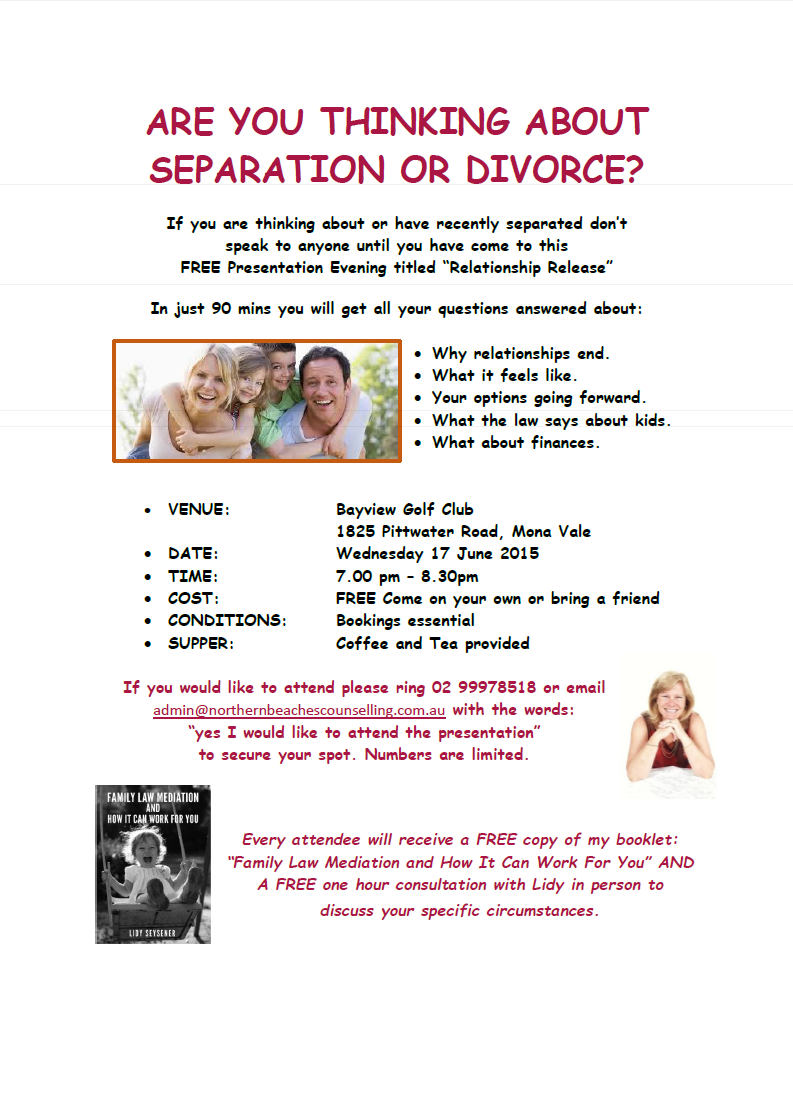
Click on the flyer to see it in full size.
If you would like to attend the free presentation please ring 02 99978518 or email admin@northernbeachescounselling.com.au with the words: “Yes I would like to attend the free presentation”.
Click on the flyer to see it in full size.
If you would like to attend the free presentation please ring 02 99978518 or email admin@northernbeachescounselling.com.au with the words: “Yes I would like to attend the free presentation”.

Has your partner made an error that has hurt you? Have you made errors that have hurt your partner?
The closer you are to someone, the more likely you are to ‘step on their toes’. And being in a relationship with someone certainly puts you where this is fairly likely to happen. Relationships are a bit like ballroom dancing really! The chances are even pretty high that you and your partner could have pretty sore toes.
The point here is that it’s normal for you and your partner to make mistakes and to inadvertently step on each others toes. And as long as this is not intentional it is repairable. Like ballroom dancing, once you get the steps right the dance will flow naturally all by itself.
And, except in the case of physical abuse, (I addressed that in my blog of a couple of weeks ago) you can move on from anything. In fact, your marriage can end up even better!
I know…you’re probably thinking, ‘Better? How could it be better than before we messed it up?’
It can be better, but you have to do one thing first. You have to forgive.
What does it really mean to forgive?
Many people say, ‘I forgive you’, but continue to hold anger and resentment in their hearts. Some people even say the words, but their actions show that nothing’s changed for them at all.
Other people will say ‘I forgive you’ but what they really mean is, ‘I can’t deal with it. I don’t want to talk about it any more.’ And so the 3 magic words come out and form a wall that shuts out their partner. True, they may not be angry any more, but that’s because they’ve shut down all emotion and refuse to reconnect.
Saying ‘I forgive you!’ is an entirely different ball game from truly forgiving.
Let’s take a closer look at the word and where it comes from. The root of the word ‘forgive’ is the Latin word ‘perdonare’ meaning: ‘to give completely without reservation’. This is also the source of our English ‘pardon’.
When the Latin ‘perdonare’ was adopted into the Germanic ancestor of English, it was translated piece-by-piece: ‘Per’ was replaced by ‘for’, a prefix that in this case means ‘thoroughly’ and ‘donare’ with ‘giefan’ (to give). The result, ‘forgiefan’, appeared in Old English meaning ‘to give up’ or ‘allow’ as well as ‘to give in marriage’.
In modern English, ‘forgive’ has also taken on the meanings of ‘to pardon for an offence’, ‘renounce anger at’ (I truly forgive you for stepping on my toes) and ‘to abandon a claim on’ (as in ‘forgive a debt’).
What then is true forgiveness? It’s when you stand as close to your partner as you stood the day your feet got stepped on. It’s when you give of yourself like you did before you were hurt.
Forgiveness might also need to be of self as well as of the other. That might sound surprising but for your partner to have stepped on your toes your toes needed to have been there to be stepped on. As the old adage says: ‘It takes two to tango!’
And, by the way, forgiveness may not be easy to do. But it is possible. You can forgive each other and move on.
And once you forgive, you’ll see that your marriage can be better than it was before.
You could even be happy that the mistake was made (in a strange way) because it allows you to realize that you might never have achieved the love you finally have without that error as your catalyst.
Did you know that when a broken bone heals it’s stronger than it was before it was broken? You too can be stronger than before things broke down between you.
Did you ever make love after a big fight? Did you ever think after you made-up, ‘Hey, this is great? We should fight more often.’ Sometimes, while not an excuse to fight, the highest-highs can follow the lowest-lows. This is because in the forgiving you have come to an even more intimate place with each other.
If you are holding onto old hurts maybe it’s time for you to forgive. Give it a go it can be so liberating for you personally as well as for you as a couple.
So until next time – Relate with Love

Click on the flyer to see it in full size.
If you would like to attend the seminar please ring 02 99978518 or email admin@northernbeachescounselling.com.au with the words: “Yes I would like to attend the seminar”.


Men who are truly OK in their masculinity, find a woman, truly OK in her femininity, simply irresistible.
I met with a couple yesterday, let’s call them George and Sarah, (not their real names) who just seemed so typical of many young couples I meet these days.
George is a healthy young man who, now in his mid thirties, has had a lot of freedom in his life to pursue his own interests. These have often been around ‘boy’ things like cars and football, and much of his adult life has been around satisfying his wants for the moment without too much concern for the future. He has a great job and sufficient income to support a good life so, in his own mind, really wants for nothing.
Sarah is a healthy young woman who is in her late twenties; a career woman with a brilliant future, and, as well, with her sites very focused clearly on her future, not only in terms of career, but also in terms of relationship and possibly even a family.
Sarah and George have now been in a relationship for over a year and they came to see me because they are in a rut not seeming to be going anywhere. For him it’s about feeling that she is asking for more than he feels he can give right now. And for her it’s a desperate want to feel safe in this relationship with the knowledge that it really is going somewhere.
Maybe the real struggle here relates to commitment and even though it might seem that this may be more of an issue for him it might be for her as well.
Let me explain this. What I see when a couple presents with this sort of issue is maybe nothing more than good old-fashioned FEAR! So, I hear you say, I can see why he might be fearful, given that he is potentially being asked to give up some of his free and easy lifestyle, but how is that showing in her?
My thought on this is simply this: If someone needs to be constantly reassured by another to feel truly OK within themselves, then it may come from a lack of OK within themselves in the first place. The danger then is this; what it is you want most and fear not getting, because of a belief within yourself that you are not deserving of this thing, in this case being love and commitment, may actually create a ‘self fulfilling prophecy’ and indeed result in the loss of that thing after all.
Wow!!! Is that a head spinner or what? You might need to read that through several times to actually get what I’m saying.
And here’s my final thought on this topic of commitment. Some Fear, as long as it doesn’t hinder us to such an extent of inaction, can be a good thing really and, from my perspective, may be even a necessary part of the process of making a commitment to another in relationship. If we really value ourselves and each other and make our relationships important enough then they deserve serious consideration before jumping in boots and all.
My advice for George and Sarah? Given that they seem to be well-matched, even though there are also many differences, for him my suggestion was to jump in and do whatever to let her know that, beside himself, she is the most important thing in his life. This means that he makes her even more important than his mates and his job and all the other things that might distract him from being truly present in this relationship.
And for her? Maybe she needs simply to come to believe that she is the best thing that has ever come into his life and trust that if she truly believes that and acts accordingly the validation she seeks will then naturally be there for her.
As the old saying goes: Sometimes you have to feel the fear and do it anyway!
You may agree or disagree with what I have said here. Either way let me know how it strikes you by responding in the “Comments’ link at the bottom of this blog.
So until next time – Relate with Love
Click on the flyer to see it in full size.
If you would like to attend the free seminar please ring 02 99978518 or email admin@northernbeachescounselling.com.au with the words: “Yes I would like to attend the free seminar”.


I think this is a brilliant question. It’s about the difference between Unconditional Love and Conditional Love.
I’ll come back to this question in a moment. Let me first tell you a story.
Barb, aged twenty-one, and Baz, aged twenty-four, have known each other for several years and are planning to marry someday soon. Both of them are still discovering who each other is and, like all young couples, have certainly had their fair share of ups and downs.
Barb has had some questions more recently about whether Baz really loves her while Baz is having his own concerns about Barb’s seeming constant need for attention. It seems that Baz is starting to pull away somewhat as he claims his own life back while Barb is feeling her self-esteem is being challenged.
In truth Barb and Baz are a fairly normal couple and are doing exactly what all normal couples should be doing at this stage of their relationship. Having passed through the “honeymoon” stage of their relationship, where everything is rosy and it feels like you have found your soul mate, you are now going through the stage where you actually can see each other warts and all.
This is now the stage when you are making the decision about whether you like each enough to want to spend the rest of your life together. It is the stage where you must separate somewhat from each other as you reclaim your identity separate from each other. Normally this also means that one of you will start the process before the other as the pull will be stronger for one of you over the other.
It is also a time where relationships are either made or results in you separating fully from each other because of the impact of this stage on your self-esteem.
There are many questions being asked at this time not just about your compatibility but also about whether you are committed enough to this relationship to continue to work on it as you work on your own personal growth.
As you both go through this mini separation you also are challenged by the learning that maybe you don’t know each other as well as you may have once thought and indeed at times it might seem like you don’t really know each other at all.
The difference between conditional and unconditional love is that conditional love has some proviso attached to it: “I’ll love you if …” Sometimes this is actually spoken out loud but as often it is just a silent thought, maybe only heard unconsciously.
Unconditional love is love that is given regardless. It has been said that the only time we really experience unconditional love is just after our birth and even then maybe only for as long as our mother and father are able to stay awake till they need to get to sleep themselves from exhaustion.
You then spend the rest of your life searching for that unconditional love again most often to no avail until you meet the love of your life. And even that only lasts for a short time before it too seems to be taken away.
And that’s when you are left with questions like the following: “When you ask your partner to hold you, and they do, are they holding you just because you asked them to or because they want to?”
In our fairy tale world we would like our partners to instinctively know what we want and provide it unconditionally. We are still seeking our mother substitute.
The sad thing is if we believe this we will never enter into a relationship at all. This is for the simple reason that there is no-one in the world who can know you as well as your mother did when she gave birth to you. Your very survival depended on her knowing what you needed and to understand what every utterance you made meant before even you did.
As adults, we are no longer connected with another human being that way, and it would be unhealthy if we did, which also means that if you want something from your partner you will have to ask for it or else they won’t know.
If they then fulfil your request don’t look too deeply into the reason why, just accept it as a sign of their unconditional love for you for which you need do nothing in return other than give them your love unconditionally when they request something specifically from you.
So until next time – Relate with Love
So often I am told about infidelities, hurts and disappointments between couples and then asked whether the offenders should be given another chance.
I think the question is often asked because the offender has felt some remorse for the misdeed and they, both in the couple, are hoping that this is enough to get them back on track. The question is also generally asked following a statement from the injured party confirming a continuing love for the person despite what they have done.
The sad thing is that remorse in and of itself is rarely sufficient to change a person’s behaviour. This is because if the underlying need or belief hasn’t changed then the behaviour may not either.
Let me see if I can make this clearer.
From my experience a typical scenario goes like this. The person who has more invested in the relationship will accept the others apology welcoming them back into the relationship without any requirement. Sadly, while things might be good for a period of time, what most often happens is that the person will likely offend again as nothing has really been learned or really has changed. There may not even have been any real conversation about what happened let alone why it happened.
And here’s another common scenario. There has been an infidelity and the relationship has broken down completely with the couple separating. The person who committed the indiscretion now feels free to enter into a relationship with the party with whom they had the affair who happily takes the person in believing most likely that all manner of wrongs from the other’s partner is the reason for the infidelity. They never even contemplate that the issue may actually have been with the offender and that likely nothing was actually learned to ensure that the person would not digress again.
What often ends up happening is that this couple finds themselves in exactly the same place as the previous relationship and so once again the offender strays from the marriage to attempt to find what is still missing from their lives in the arms of someone else.
What really needs to happen in these circumstances is that each party takes some time to try and figure out why the behaviour happened in the first place. Was it because some need was not being met or that there is actually a mismatch in the things that each party holds valuable about themselves, their spouses and their marriage.
So the way forward is firstly to communicate with each other openly and honestly about what is going on for each of them. They also need to discuss what they feel and think about their relationship and their part in it. Finally, and maybe this needs the assistance of a couples therapist, they need to share with each other what is really important to each of them about being in a relationship and to discover whether there is a match in those values.
If there is a match then the likelihood of them succeeding into the future is reasonably assured.
If there is no match then they need to determine whether they are willing to live with this and the consequences or whether they can save themselves and each other a lot of heartache by acknowledging those differences and separating from each other immediately.
Of course this course of discovery would be better done prior to entering into the relationship in the first place. And this is where preparation for marriage counselling is most valuable; simply ensuring your compatibility prior to saying “I do!”
So until next time – Relate with Love
Click on the flyer to see it in full size.
If you would like to attend the free information evening please ring 02 99978518 or email admin@northernbeachescounselling.com.au with the words: “Yes I would like to attend the free information evening”.

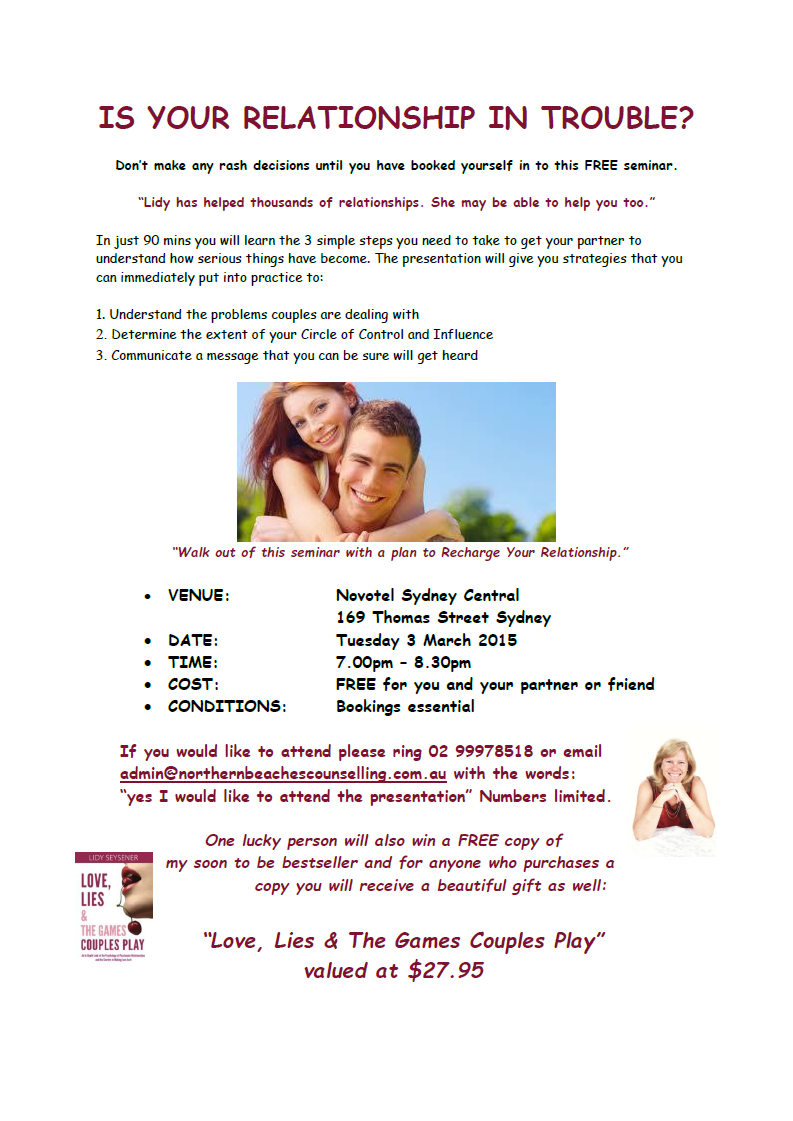
Click on the flyer to see it in full size.
If you would like to attend the seminar please ring 02 99978518 or email admin@northernbeachescounselling.com.au with the words: “Yes I would like to attend the seminar”.
I loved receiving this question as it’s something that we may expect that we all understand but in truth maybe we actually don’t.
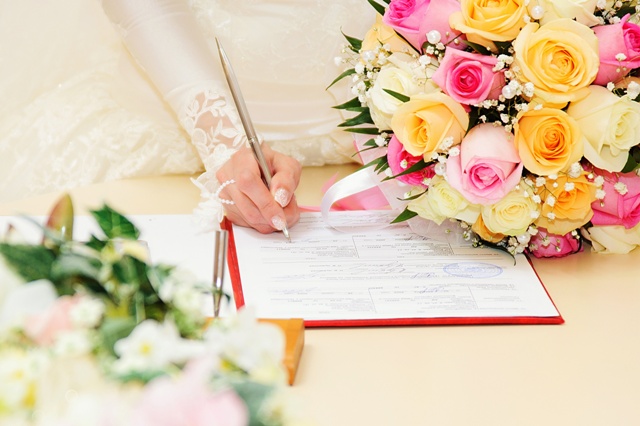
So I started my research into answering this question by scrambling to the Macquarie Dictionary which defines marriage as “the legal union of a man and a woman for life including a legal or religious ceremony.”
This definition really doesn’t give us very much at all as marriage today in so many cultures, legally and through the various churches, is open to being dissolved on the wish of one or other of the parties. In most countries these divorces are even permitted without even having to prove that one party is in some way more at fault than the other.
So I thought that I should proceed in this article to discuss my thoughts on what marriage is and would welcome you to add your thoughts on the topic as well.
While marriage may relate to a legal process for me marriage is more about the commitment two people make to be there for each other come what may. I would also expand on the dictionary definition to include not just the communion of a man to a woman but also of either a man or a woman to another man or woman. In my view they are as much a marriage as any marriage could be.
The sad thing here is that too many people enter into a marriage without really knowing what they are getting themselves into or without going through any preparation to ensure that their marriage will go the distance.
When I work with couples contemplating marriage the first thing I get them to consider and discuss with each other is this very question: what is marriage to each of them? How do they define it and are they ok with how their partner defines it or does it need some tweaking to make it something that both of the couple can live with.
As most of you might know I am in a relationship and have been for more than 20 years. My partner and I are not married nevertheless I describe him as my husband and wear his ring. He also describes me as his wife. It actually took us some time to acknowledge each other in this way as we were assessing our future together especially as I had four young children already as part of the package.
One of the first things we discussed in terms of our marriage was about whether we would live together and where that would be. We then had many conversations about how we would manage my children and whether we would have any more children. We then had to decide on the division of responsibilities both in terms of household chores and financial contributions. Finally we had some conversations about ownership of property and what would happen in the event that either of us predeceased the other.
And while this was not an issue for us as we are both of the same religious beliefs, for many couples there is also the question of what their particular religious beliefs are and how they might impact on their relationship and/or to any children of the relationship.
So while some of these issues are still conversations in progress for my partner and myself, the underlying promise is that we will be there exclusively for each other for the rest of our lives. In this we committed to never walk out on the other and to always raise it whenever we had an issue that affected us both and/or our future together.
This is how I define my marriage for me. It is a safe place to collapse into at the end of each busy day where I can feel safe and not be judged negatively no matter what I do or think. It is a place where I feel loved unconditionally and love in the same way.
So until next time – Relate with Love
 Relationship Remedy