The Martyr’s Checklist

Many of you are asking ‘how to …’ questions so in this week’s article/blog I have selected ten of the most common ‘how to’s …’ to answer. These are just my thoughts so do go to the comments link and add your own.
The song written by Rudy Clark in 1964, and made famous by Cher in 1991, titled ‘It’s In His Kiss’ may answer some of these questions. Here are the lyrics:
Does he love me?
I wanna know!
How can I tell if he loves me so?
(Is it in his eyes?)
Oh no! You need to see!
(Is it in his size?)
Oh no! You make-believe!
If you wanna know
If he loves you so
It’s in his kiss!
(That’s where it is!)(Oh yeah! Or is it in his face?)
no girls! It’s just his charms!
(In his warm embrace?)
no girls! That’s just his arms!
If you wanna know
If he loves you so
It’s in his kiss!
(That’s where it is!)
yeah!! It’s in his kiss!
(That’s where it is!)Oh, oh, oh, honey !
Squeeze him tight!
Find out what you wanna know!
promise love, and if it really is,
It’s there in his kiss! …
Is it really in his kiss, or in his eyes or face or arms? Or is it in none of these? Does this song really sum it all up or is there more to it.
Well, I think there is a whole lot more to it. And if you think the answers are to be found anywhere outside of the relationship, I think that you might also be looking in the wrong place.
So if the answers are not in their kiss, and not out there, where are they?
I’ll answer that question in a moment. Let me firstly say this: What these kinds of questions echo for me is that either you’re not asking the right questions or you just don’t trust yourself, or your intuition, enough to believe that what you’re hearing is the truth, or that they are actually lies.
Or maybe you’re just not asking any questions at all out of fear of what you’ll hear or worse, that you might get an outright rejection. Maybe this is because you’re not yet sure enough about your own love; either of the other or of yourself or do not have an absolute belief that you are worthy of love. What happens then instead is that you try to guess what’s really going on or hope that someone else may be able to help with the answers.
Maybe the issue here is really about trust: Trust of yourself to know the truth when you hear it and/or trust of the other to believe that what they are saying will answer your questions truthfully.
So where do you find the answer to these questions? Ask the person who really should be answering them. The truth really is there, and is plain to see when you open yourself to it. Be brave – ask the questions you really want to know the answers to and trust that he or she will answer you honestly. Then look into your own heart to determine if the response actually is the truth: If it is you’ll know it. If it’s not or you still are not sure maybe this person is not the one you should commit yourself to.
If, after getting the answers to your questions you feel sure about the answers then kiss him or her often and take the time to make it heartfelt. Show him or her through your kiss that you truly love them. The only question I have for you then is ‘how could they not love you forever?’
So until next time – Relate with Love

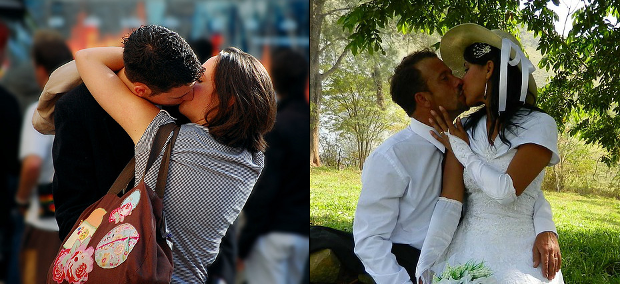
I receive countless emails on the topic of getting married versus living with your partner with the possibility of one day getting married and all the apprehension that goes with that decision. So in this article/blog I’m going to address these questions as I understand them and welcome your comments as well.
I also receive many questions about arranged marriages, and the consequences of that on the couple, as well as about marriages that are not arranged and do not have the approval of family.
1. Boy meets girl – they fall in love – they commit to each other and set up house either with a view to getting married or having just done so.
2. Families introduce the couple – they live with their own families until they get married often not even meeting, or if so briefly in the parents company, before their wedding day.
Researchers have looked into each of these scenarios, amongst others, to determine what situations give the best long-term outcomes for couples.
Generally over the long-term arranged marriages have the highest rate of success. That is not necessarily to say that these couples are the happiest but, due to the cultural structure of their communities, where women particularly often have less input into their life decisions, the permanence of these relationships is pretty much guaranteed.
Another indicator coming from the research is that marriages that have resulted from a courtship whereby the couple has lived separately until their wedding day also seem to have a higher success rate than couples who have lived together prior to becoming married.
The lowest long-term success rate comes from couples who live together before they marry or who live together without marrying at all or who have only known each other for a short period of time before marrying.
My hunch is that there is a common denominator here that is to do with commitment. This commitment however could be self-directed or other directed. In the case of an arranged marriage there may be a commitment based on lack of perceived choice. While on the other end of the continuum, the couple who live together without making a long-term commitment, may actually not have given enough thought to the decision and consequently may feel more able to step away from the relationship if things get too hard.
This is a huge generalisation based on a set of figures which of course is just that; numbers not real people.
I look forward to your stories to tell me of outcomes that are contrary to the research results, for good and for bad, and maybe we can conduct our own research to see what structure relationships take that have the best outcome.
There is another set of figures being published too that says that second marriages have a higher failure rate than first marriages. This is often blamed on the additional stress of there now being children in the relationship or that someone has not learned their lessons from the first relationship and thereby just gets into the same negative place again.
And in terms of going against statistical norms I will be the first to hold up my hand. I met my current partner just as I was ready to end my previous relationship. I don’t mind saying that while we have never married we have now been together for twenty plus years and each year just gets better and better.
So what does all this tell us? Simply this: there is no best way to choose a partner or to choose a type of relationship or even a best time to marry. This might also mean then that there is no optimum time to know each other before committing to a relationship nor a best age to do this.
The most important thing is that you love each other and respect each other and treat each other as if you are the most valuable thing in the world. This presupposes that each of you is at peace within yourself. Sometimes this means making it more about your partner than about you. If you can do this then whatever arrangement you have will work.
A really important thing to remember is that relationships can be fragile and need regular nurturing and care. Don’t ever treat another person as someone to own or to have control over or to force into a relationship without their want. This is not respectful or favourable to being loved.
So until next time – Relate with Love






 Relationship Remedy